
Author Archives: Vikram Murarka

Vikram Murarka

About Vikram Murarka

Chief Currency Strategist at KSHITIJ.COM. Likes to look at the markets from many different angles. Weaves many conventional and unconventional technical analysis techniques and fundamental analysis into a global macro perspective. Likes to take the road less traveled.

Hedge Exposure

Your Exposure is your Position

Most corporate risk managers refer to their hedges, such as forward contacts, as their “market position”. They think that taking a hedge is the same as taking a trading position in the market. This is because taking a hedge is an act of volition, undertaken after due deliberation. Something is consciously done. The risk manager says he has taken a “market position”. Further, there is a tendency to cancel and rebook forward contracts (something that has been curtailed by the RBI’s Dec-11 guidelines), which has tended to give the hedge the flavour of a trading position.
Payoff on unhedged exports

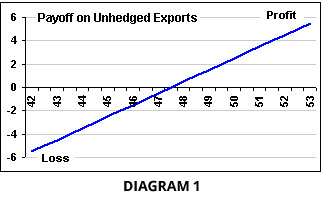
However, this is incorrect. The hedge is not the company’s actual market position. It is a transaction undertaken to offset, or square off, or negate, the actual underlying position that the company has in the market, as a result of its fundamental business transactions. See diagram 1.
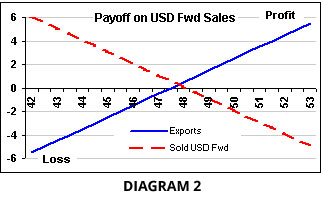
Payoff on USD forward sales For instance, an Exporter who is to receive Dollars after 3 months has an intrinsic Long position in the market. The value of his receivable Long position increases if the Dollar rises against the Rupee, it decreases if the Dollar falls against the Rupee. In other words, the export receivable is exposed to market fluctuations, and is, in actuality, his position in the market. See diagram 2.

Exports hedged with forwards

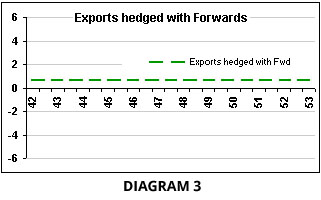
If the Exporter now sells Dollars Forward for 3 months against this export receivable, he is hedging or closing out or squaring off his export receivable position. If the Dollar moves up against the Rupee, the gain on the exports is offset by the loss on the forward contract. On a net basis, therefore, the value of the Export Receivable is no longer exposed to market fluctuations. The position has been closed through the hedge, through the Forward Sale contract. See diagram 3.

Similar, but opposite is the position of the Importer, who is Short Dollars in the market by virtue of his imports. He has to buy Dollars in the market to make good his payment obligation. When he actually buys Forward Dollars, he is not taking a fresh position in the market. He is simply covering his exposure, providing for his payment obligation, squaring off the risk of Rupee depreciation.

Unfortunately, since the Risk Manager does not himself undertake the export or import transaction, or because the actually underlying position is created by default, there is a tendency to not recognize it for what it is, viz. the company’s actual position in the currency market. It is unfortunate because this misunderstanding causes the company to ignore and overlook the profit or loss on its actual position and instead focus on the profit or loss of its hedge. This is akin to losing sight of the woods for the trees, because, usually, the quantum of the actual underlying exposure is greater than the quantum of the hedge.
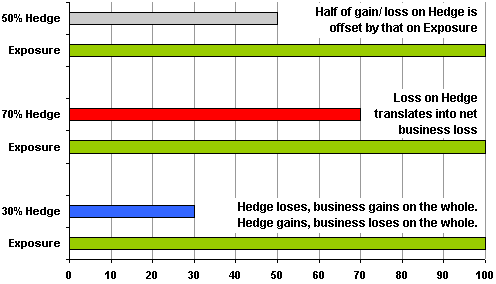
Hedge ExposureThus, when a hedge, whose quantum is, say, 30% of the actual underlying exposure, makes money, there is no reason to be overjoyed. Quite obviously, when the 30% hedge is making money, the balance 70% unhedged exposure is losing money. Similarly, if the 30% hedge loses money, that is no reason to crucify the risk manager – the balance 70% unhedged exposure is actually making money. In fact, therefore, if the hedge ratio is less than 50%, a loss making hedge is to be preferred to a profitable hedge.


Featured Video Play Icon

Never 0, never 100, and not in one go!

One of the most agonizing difficulties commonly faced by the risk manager is not knowing where the market is likely to go. This makes it nearly impossible for him to decide whether to hedge or not to hedge. To put an end to his indecision, and not knowing what to do, he often leaves the exposure unhedged. His line of thought is, “Who knows whether taking a hedge will be right or wrong? It is better not to do anything. Who will take the blame if things go wrong?” Very often, the CFO/ CEO/ MD also agree with the risk manager, coming up with a number of justifications for the decision.

The strategy of inaction works well enough if the market is either stable or is moving in favour of the exposure. Unfortunately, the happy state of affairs does not last forever and the risk manager often ends up hedging in a state of panic when the market starts to go against him.

Underlying the above practice are two misconceptions:

  1. The risk manager has a responsibility to hedge at the highest rates (for exports) and lowest rates for imports.
  2. When he hedges, the risk manager should hedge 100% of the exposure.

However, the seasoned risk manager knows that it is not possible to strike the tops and bottoms of the acceptable average rate for the hedge. The simple trick he employs is to hedge the exposure in parts instead of as a whole. He might break up the exposure into 3 parts, or 4 parts or even 10-12 parts, and then proceed to hedge each part at different rates and at different times in the market.

Hedge in steps

Since the hedges are undertaken at regular intervals, when the risk manager follows this strategy consistently over a sufficiently long period, he gets several benefits, as enumerated below:

  • Is able to achieve a decent average rate.
  • Does not have to worry about trying to achieve the highest or lowest rates. Or in other words, he does not have to try and “time” the market.
  • Even if a couple of forecasts, on which the hedges are based, go wrong, it is not a major worry because (a) the wrong forecast does not impact the entire hedge and (b) there are good chances that subsequent forecasts will go right.
  • Dramatically reduces the arbitrariness and ad-hocism in the hedging process and greatly enhances the systematic aspect of hedging.
  • All of the above, together, make the whole hedging process much more robust than if each exposure were to be hedged in one go.

Further, it has been our experience that in the hands of a skilled risk manager, this strategy can go so far as to help the company achieve an average realization rate that is better than the average market rate.


So, remember, do not leave your exposure totally unhedged, do not cover it fully at one go. Try and hedge in steps.

How about early delivery?

How about Early Delivery?

Exports Option Delivery

Many clients we work with, especially SME clients, and more especially Exporters, tend to prefer an “Option Period” Forward Contract rather than a “Fixed Date” Forward Contract.

Option Period Delivery

The “Option Period” Forward Contract is an exotic animal, most likely found only in the Indian forex market. Why do Exporters like this strange hedging instrument so much? What “perceived” benefit does it give them? How does it work? And why is it actually a sub-optimal instrument?

Many exporters do not enjoy the luxury of exporting on the basis of strict L/C terms. As such, many a times they do not know the exact date on which their receivable will materialise. At best they have a rough idea of the time period in which they can expect their customer to send the payment. Hence, when they want to undertake a Forward (Sale) Contract against their receivable, they are unable to give a specific value date for the forward contract to their bank. This is a common problem.

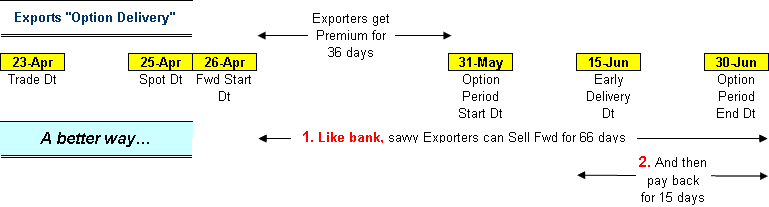
So, the banks have come up with what looks like an attractive, accommodative and customer friendly solution, which is often more profitable for the bank than for the customer. In a magnanimous gesture, the bank “allows” the exporter to deliver the Dollars within a specified period (often a calendar month) instead of on a specific date. For example, on 23rd April, an Exporter who is expecting to receive payment by end of June is allowed to enter into a Forward Contract to sell Dollars to the bank any day between 1st and 30th June. For this, the exporter is entitled to get the Forward Premium for the period 26-April to 31-May, or for little more than 1 month. Note here that the forward period will be counted from 26-April onward since 25-April is the Spot date for 23-April.

The bank, on the other hand, can go out into the market and sells Dollars forward for value date 30-June, instead of value date 31-May! In other words, it sells 2 months 5 days forward gets premium for 66 days (26-Apr to 30-Jun) instead of for 36 days (26-Apr to 31-May).

Early Delivery

What happens in case the payment comes in earlier than 30-Jun, say on 15-Jun? Under the Option Period Forward Contract, the exporter simply delivers the Dollars to the bank and is credited with the Forward Rate, as previously agreed, that was then applicable on 23-April, for 31-May. He is unaware of the fact that he has foregone premium for 15 days. What does the bank do, on the other hand?

The bank, which had previously “received” premium for the entire period from 26-April to 30-June from the market, “pays” premium for the period 16-June to 30-June, back to the market. On a net basis, therefore, the exporter receives premium for 36 days months whereas the bank receives premium for 51 days.

This is pure profit for the bank, which could as well have been to the account of the Exporter if he had done the same thing as the bank, viz. (1) Sold Forward for fixed date 30-June (2) Given Early Delivery on 15-June and (3) Paid back premium for the period 16-June to 30-June through a swap transaction.

An Early Delivery is a perfectly correct and legitimate transaction, well within the RBI’s guidelines, and has been around for at least two decades, quite possibly longer. Many Exporters do not avail this facility because they are either not aware of this facility or they do not want to take on any additional administrative work.

Bad For Importers Also

The Option Forward Contract is bad for the Importer as well. Say on 23rd April, an Importer asks for an option forward contract for the period 01 to 30-June, he is asked to pay premium for the full 66 days from 26-April to 30-June. Instead, he could have asked for a fixed date forward contract for value date 30-June. Then, if has to “take” early delivery of the Dollars from the bank on 15-June, he can ask to be refunded the then prevailing forward premium for 15 days, from 16-June to 30-June.

In this manner he ends up paying premium for only 51 days, instead of for 66 days.

Need To Wake Up

Both Exporters and Importers need to wake up and look at the amount of money they are losing by taking option period forward contracts and not hedging for a fixed date. The average monthly premium over the last couple of years has been 20-30 paise. We can safely assume that roughly half of this is foregone when an Exporter asks a bank for a option period forward contract instead of giving “early delivery” on a fixed date forward contract.

10 paise foregone on every $ 1 million sold every month translates into foregone revenues of Rs 12,00,000/- every year. Is that worth losing? Or is it worth capturing? You decide.

Importer Option Delivery

The forward rate is not a forecast

The Forward Rate is not a Forecast

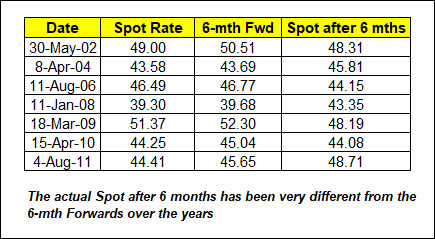
This might be a little basic for old hands in the market, but there is often a misconception among new entrants that the Forward Rate is a forecast of where the rate is going. For instance, if on 09-May the Dollar-Rupee Spot rate is 52.82 and the Forward Rate for 30-June is 54.39, many people think that market is expected to be at 54.39 on 30-June. This is not the correct interpretation.

Function Of Interest Rate Differentials

In the forex market, the Forward Rate is not a forecast. It is simply the rate at which the market is ready to transact today, for a future date. Therefore, 54.39 is the rate at which the market is willing, on 09-May, to transact for value date 30-June. That’s it. The actual rate on 30-June is quite likely to be either much higher (maybe 55.30) or much lower (maybe 52.00) than 54.39.

Yes, this does not seem to make sense. Why should the market transact at 54.39 for 30-June if the rate is not expected to be at or near 54.39 on 30-June? How can the banks (the dominant players in the forex market) risk a loss? The fact is that the banks are not taking a view on the future exchange rate when transacting a Forward Rate. They are really lending one currency and borrowing another currency for the same stated value date (or maturity date) and the Forward Rate is calculated so as to bridge the interest rate differential between the two currencies. Thus, neither of the banks on either side of the trade stands to make a loss from an interest rate perspective. This is how the forex forward rate came into being and is arrived at even today. The forward rate is simply a function of the interest rate differential between two currencies. It is not the expected future exchange rate.

EURUSD Forward Rate

Here’s Proof

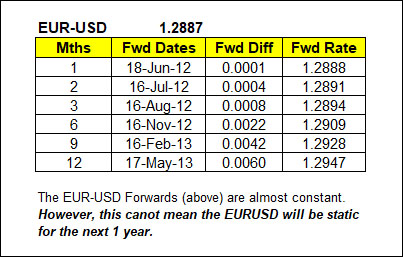
Hard to believe? OK, here’s proof. The interest rates in USA and Europe being very low, the interest rate differential between the USD and the EUR is negligible. As such, the forward rate for the EURUSD is almost the same as the spot rate. For instance, on 14-May, the 3-mth USD Libor is 0.47% while the 3-mth EUR Libor is 0.62%. Thus, the interest rate differential is 0.15% and the 3-mth EURUSD forward rate is 1.2894, which is almost the same as the spot rate of 1.2887.

If the forward rate were the forecast of where the market is going to be in the future, the implication of the above paragraph would be that the EUR-USD rate should not go anywhere for the next three months; or in other words, the rate is going to be same three months hence. However, we know that this is not possible. The Euro has at least a 66.7% chance of moving around (whether up or down) rather than remaining static. Therefore, whatever else it may be, the forward rate is not a forecast for the future.

The above is especially true of forward exchange rates among countries which have allowed free flow of capital between themselves, or countries with full capital account convertibility. Even in India, which has limited capital account convertibility, the interest rate differential between USA and India now influences the short-term forward rate to a large degree, especially given the fact that progressively larger amounts of debt inflows are being allowed into the country which the foreign investors are allowed to hedge in the domestic forex market.

Dollar-Rupee Forward Rate

Market Moves Different From Forwards

In India, the forward US Dollar is usually quoted at a premium to the Rupee, or, the Forward Rate is higher than the Spot rate. If the forward rate were to be a relatively accurate forecast of future Spot, then the Rupee ought to have depreciated against the Dollar all the time, it should never have appreciated. However, we have seen episodes of significant Rupee appreciation – from 49 to 39 (2002-2008), from 52.18 to 43.85 (2009 to 2011) and from 54.30 to 48.60 (2011 to 2012).

Yes, the Futures in other markets such as commodities, interest rates and equities, could be taken as the prevailing market consensus about where the market rates will end up in the future, but not so in the forex market. This is a peculiarity of the forex market. Most people who enter the forex market harbour this misconception initially, but it is thankfully corrected pretty soon.

So, next time you want to know where Dollar-Rupee is going to be in the future, don’t rely on the Forward. Look for a professional forecast!

Use a forecast for budgeting

Use a Forecast for Budgeting

Most exporters price their goods on a “cost plus” basis. They add a certain cushion for forex volatility to their domestic costs and quote a Dollar price accordingly. Importers take whatever Dollar price they are able to negotiate. Both the export/ import contracts are then accounted for in the books at the current exchange rates.

Thereafter, the exporter/ importer hopes that the rate on the date of actual receipt/ payment should remain the same as that on the date of the business contract, so that he does not have any forex profit/ loss. Thus, most export/ import deals are, by default, cost-budgeted on the present. But, the future is usually different from the present and when the time for payment/ receipt comes, there is a forex profit/ loss compared to the booked value of the deal. This is a problem. How does one budget for the future transaction?

Forecast as a benchmarkIf the future were known, one could have used the future rate to price the export/ import transaction and to budget accordingly. But, nobody knows the future, right? So, some businesses tend to use the Forward Rate as a proxy for the future, simply because it is a rate that pertains to the future.
 

THE FORWARD IS A FAULTY BENCHMARK

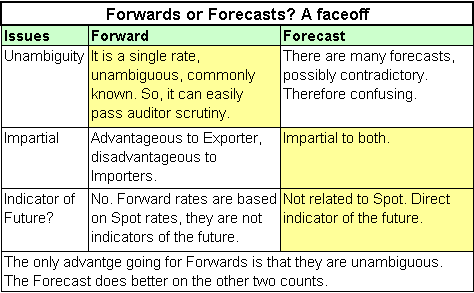
But, using the Forward Rate has two problems. The first is that the Dollar is usually at a premium to the Rupee in the forward market. This premium is an earning for an exporter, but is a cost for the importer. The Exporter may be able to accept a lower Dollar price for his goods (being compensated by the premium for the dent in his profit) but the Importer would have to be ready to pay a higher Rupee cost. This is a conundrum for companies that have both exports and imports. A true benchmark should be impartial to both the exporter and the importer.

The second problem is that the forward rate is not a forecast and it is incorrect to use it to budget for a transaction that is to take place in the future. So, what is the solution?

USE A FORECAST AS A BUDGET

The answer is to use a currency forecast as the budget rate for the future payment/ receipt. “If only it were possible!” you would say, Dear Reader. “I would do it, if I had a reliable forecast. But, nobody can forecast currencies!”

This notion is true to some extent and untrue to some extent. Yes, currencies cannot be forecasted exactly. However, they can be forecasted with a reasonable degree of accuracy, within an acceptable degree of variance. And, such forecasts can serve as better budget rates than the Forward rates.

MARKETERS DO IT ALL THE TIME

Let us, for a moment, look at forex risk management not as something esoteric but as a normal part of business. The sales and marketing departments in all companies make their budgets and fix their targets based on market forecasts. These forecasts are not expected to be sacrosanct. A degree of variance is always assumed. The sales forecasts/ targets are revised periodically, on a quarterly or monthly basis. This is the normal business practice. Thereafter, the company tries to meet or beat its internal sales targets.

Currency forecasts are to be approached in the same manner. Neither the professional forecaster nor the user of the forecast should harbour the notion that the forecast is sacrosanct. The forecaster should also not stubbornly stick to his forecast (even as it is going wrong) just because he has done the forecast. Nor should the user berate the forecaster for getting it wrong.

Of course, this does not mean there should be no accountability and the forecaster can say just anything and get away with it. The professional forecaster should pursue his craft with diligence, keep track of his performance, inform the user of the reliability of his forecast, of the degree of variance that may be expected and will constantly try to improve upon his work. Our own forecasts have a reliability factor of 72%.

Working with a reliable currency forecast can yield dramatically improved results in forex risk management. Try it. It works.