

Author Archives: Vikram Murarka

Vikram Murarka

About Vikram Murarka

Chief Currency Strategist at KSHITIJ.COM. Likes to look at the markets from many different angles. Weaves many conventional and unconventional technical analysis techniques and fundamental analysis into a global macro perspective. Likes to take the road less traveled.

Cash Spot

Series on Forex Hedging – Cash In On Cash-Spot

Cash-Spot is one of the lesser known technical concepts in the forex market. Nothing earth shattering, really, but it is always good to know the technical details of the market we operate in. The forex rates that we see in the normal course, quoted on the screens, in forecasts or in the papers, are all Spot rates (unless specifically mentioned otherwise) and do not pertain to today. Strange? To explain a little clearly, we introduce a few definitions, alongwith examples.

CASH-SPOT: DEFINITIONS AND EXAMPLES
Term Definition Example
Cash date or Trade date The date of the transaction, say “today” If today is 25-June-12, then Cash date is 25-June-12
Spot date Second working day from the Cash date, or day after tomorrow 27-Jun-12
Tom date Tom is short for “tomorrow” and is the next working day from the Cash date 26-Jun-12
Spot Rate The rate quoted and transacted today for settlement (debit/ credit) on the Spot date Say, the rate is 55.95. This is the rate we normally see, hear and talk about.
Cash Rate The rate applicable for settlement (debit/ credit) today itself, on the Cash date This is usually lower than the Spot Rate. Since the Spot Rate is 55.95, the Cash Rate may be 55.93. The difference between the two rates is known as the Cash-Spot rate or Cash-Spot difference.
Tom Rate The rate quoted and transacted today for settlement (debit/ credit) tomorrow, on the Tom date This is lower than the Spot Rate, but higher than the Cash Rate. Since the Spot Rate is 55.95, the Tom Rate may be 55.94.

In simpler terms: Spot Date = Trade Date + 2 working days.   Cash Rate = Spot Rate minus Cash-Spot Difference.

Depends on Interest Rates

In the case of Dollar-Rupee, the Cash Rate is usually lower than the Spot Rate in the same way that the Spot Rate is usually lower than a Forward Rate. In other words, compared to the Spot Rate, the Cash rate is usually at a Discount, whereas the Forward rate is usually at a Premium. Note: any date after the Spot date is a Forward date.

The Cash-Spot market is largely a high-volume interbank market as it is based upon banks borrowing in one currency and lending in the other, usually to meet overnight reserve requirements. Thus, the Cash-Spot Difference depends on the difference between the Overnight or Call rates between the two currencies concerned.

If there is a holiday, or a couple of holidays (as over the weekend) between the Cash and Spot dates, then also the T+2 definition applies. In such case the Cash-Spot difference understandably increases.

Market Timings

The Cash-Spot market usually operates between 9.00 AM and 11.30 AM, with some stray deals being done till 12.00 Noon.

Is the Cash-Spot quoted?

Yes, the Cash-Spot and Cash-Tom rates are quoted on most forex rate services such as Reuters, Bloomberg, Newswire 18 and Tickerplant. We also report it daily in the Forward Rate Sheet that is sent out by e-mail to the subscribers of our daily Rupee Update service.

What does it mean for Exporters?

When an Exporter sells Dollars to a bank at the Spot Rate (say 55.95), he should get a credit into his Rupee account on the Spot date. If he insists on a credit on the transaction date (Cash date), the bank may well deduct the Cash-Spot difference (say 2 paise) and credit his account at the Cash rate, say 55.93. So, as a general rule, an Exporter should not insist on a same day credit.

What does it mean for Importers?

When an Importer buys Dollars from a bank at the Spot Rate, his Rupee account ought to be debited on the Spot date, and not on the transaction date. This is something that the Importer should be careful about and check on a regular basis. On the other hand, it may be good for the Importer to pay for the Dollars at the Cash rate as it would be cheaper than the Spot rate. In such case a debit on the transaction date would be justified.
Use forecast for budgeting

First step to success in hedging: Sanction a Hedging Cost Budget

An astounding thing we have encountered while advising companies on forex risk management is that almost no company has allocated a budget for meeting forex hedging costs. Companies may have voluminous FX hedging policies, in hardbound book form, put together by their risk management committees which are duly approved by their Boards. But, when we ask them whether they have approved a Hedging Cost Budget, we are met with uncomprehending stares. “Hedging cost budget? What’s that?”

Points to remember for hedgingEvery activity has a budget
Hedging forex risk is a necessary part of business. This realization is slowly dawning on more and more companies now, thanks to the sharp increase in Rupee volatility. However, the understanding and belief is not fully entrenched yet. But, thankfully, it is slowly seeping in.

Still, no one has yet started setting aside an explicit budget for hedging. Budgets are duly allocated for even mundane activities like cleaning the staff toilets, for tea and biscuits for visitors, for stationery. And, of course, there are budgets for manufacturing and marketing and for salary payments. But, there are no budgets for forex hedging. It’s almost as if hedging is supposed to be costless.

Why is there no Hedging Cost Budget?

The two main reasons for the non-existence of an explicit hedging cost budget are:

  • Most of the hedging is done using Forward Contracts, wherein the hedging cost or forward premium is built into the price. Since it is not paid separately upfront, it does not get recognized as an explicit cost. That does not mean, however, that it is not hedging cost.
  • Most companies use the Forward Rate for budgeting their imports/ exports and as such the hedging cost is implicitly added to the raw material cost or product cost. In this manner the cost of the activity of hedging is shifted to the activity of procurement or manufacturing or sales.

Why a Hedging Cost Budget is needed

That most people are doing things this way does not necessarily mean it is the best way to do things. In earlier articles we have explained how Forwards are not forecasts and are therefore not the best way to budget for future forex transactions and that it is better to use explicit currency forecasts for budgets instead.

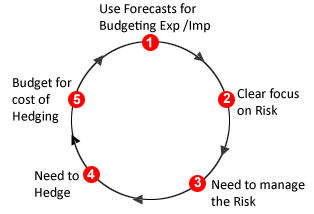
The benefit of using currency forecasts for budgeting is that you end up focusing more clearly on FX risk. From that emerges the need to manage that risk. And thereby arises the need to hedge as a means of mitigating such risk and from that, again, emerges the need to budget for the cost of hedging.

Have you ever wondered why most companies tend not to use Options as a hedging tool, even though Options are sometimes more effective than Forwards for hedging? It is because there is no budget available for paying the upfront option premium. That is also the reason why many companies who do use Options are attracted towards “zero cost options” and end up losing money in times of excessive volatility. Not having a hedging cost budget also acts as a disincentive for companies to exit unprofitable hedges.

If a company were to sanction a budget for hedging costs, it would be able to pay for Options and it would be able to accept “stop losses” on unprofitable hedges. In total, it would be able to hedge more efficiently.

Use Forecasts for Budgeting Exp /ImpHow much to budget? And, is it worth it?

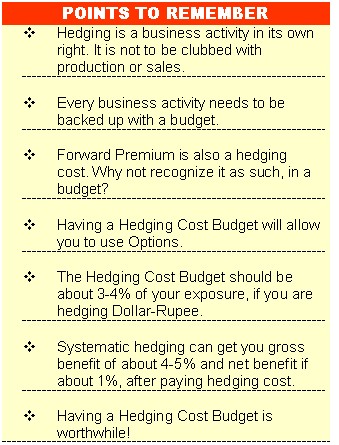
Good questions. From our experience of hedging Dollar-Rupee risk through the KSHITIJ Hedging Method over the last 6 years, we’d say that a company should budget about 3-4% of its exposure as hedging cost. And, if that sounds like a very expensive proportion, let us assure you that it is worth it. If you hedge systematically, say as per the KSHITIJ Hedging Method, you stand to save or gain about 1% of your exposure, after accounting for the hedging cost.

In other words, hedging can give you a gross benefit of 4-5% and a net benefit of about 1% over and above the hedging cost.

Is it really necessary?

We would say, yes, it is necessary to explicitly sanction a Hedging Cost Budget. By doing so, you explicitly recognize hedging as a necessary and legitimate business activity; and you commit yourself to the act of hedging.

As soon as you’ve done that, you’ve taken the first step towards success in hedging!

To know more about hedging, its costs and how to go about it, you can write to us at info@kshitij.com

Drawbacks of Common Hedging Methods

Drawbacks of Common Hedging Methods

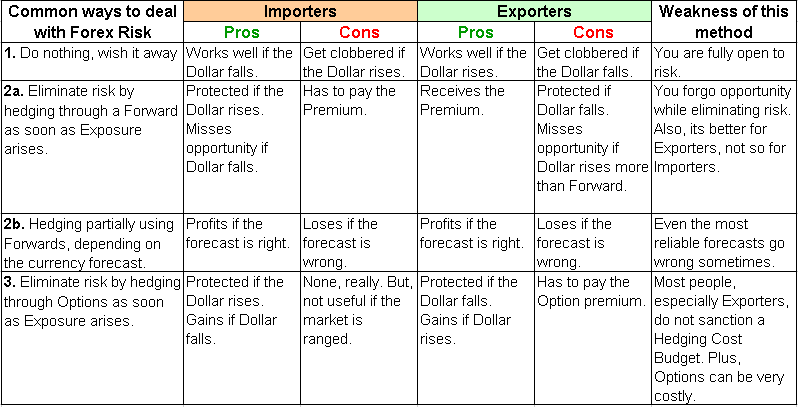
Drawbacks of Common Hedging MethodsForex risk management is a frustrating experience for most companies. There seem to be a thousand things that can go wrong at any time – the economy, the market, the forecasts, the regulations, the shipment and payment dates – and generally they do seem to go wrong all together, all the time, every time. If by any chance, or maybe by design, there is profit in any one year, it does not seem to last. Losses, when they inevitably come, tend to wipe out the profits of earlier years. Little wonder that most companies tend to give up on forex risk management in disgust, saying, “Forex is not our business!”

We disagree. Forex is very much the business of every importer and exporter. And, tackled with a common sense business approach, it can even add to the bottomline instead of constantly subtracting from it. But, that is material for another article. In this article, we shall look at how companies generally deal with forex risk management, and what problems they face.

Method 1 – Do nothing

The most common way to deal with forex risk, of course, is to wish it away, to do nothing. But sadly, as the School of Hard Knocks has taught all of us, avoiding a problem, turning a blind eye to it never works in the long run.

Method 2a – Hedge 100% on Day 1 with Forwards

The second most common way to deal with the issue is to hedge away the forex risk, by closing the original exposure or position straight away, usually with a forward contract, so that the risk is eliminated. This is a simplistic solution, commonly prescribed by textbooks and “purists” who espouse the belief that “forex is not your business.” The implicit suggestion is that the company is incapable of managing forex risk.

The problem with this method is that although risk is eliminated no doubt, one ends up sacrificing all potential profit as well. An associated problem with this method is that it is easy to adopt for the exporter who earns the forward premium, but is difficult for the importer who has to pay the same premium.

Method 2b – Selective hedging with Forwards

A variation to this method is to hedge sometimes and not to hedge at other times, based on the available market forecasts.

The problem with this method is that one doesn’t know whether the forecast is going to be right or wrong. One cannot have an idea of the chances of success. In case the forecast is prepared by the internal risk management team of the company, there is an additional risk of the forecast turning out to be biased. For instance, there’s a danger that an importer will be biased towards a weaker Dollar while an exporter would say that the Dollar is going to rise. In this, it helps to take a forecast from an external, professional forecaster, whose work is considered reliable. For instance, 72% of our forecasts are reliable.

Method 3 – Hedge exclusively through Options

The third, much less common way to hedge against forex risk is to use Options as the hedging tool, rather than the forward contract. This is a better way, no doubt, but it is still not the best way. The benefit of course, is that Options allow the company to partake of potential profit if the market moves in its favour, while eliminating the risk of an unfavourable move. It is, in a manner, the best of both worlds. The sad part is that options tend to be costly and are profitable only in trending markets. Further, most companies, especially exporters (who are used to receiving forward premium) do not have a hedging cost budget, which would enable them to pay the premium for buying options.

Ways to deal with forex risk

What is the way out?

Very well, we’ve pointed out the flaws in all the common risk management methods. Does this mean there’s no hope for beleaguered company managements? Thankfully, there is definitely a way out, and it works. In fact, it has worked for the last six years in various market conditions. We call it the KSHITIJ Hedging Method. It is built on common sense business principles and has been formulated after years of experience and trial and error.

Most importantly, it rejects the fatalistic belief that “forex is not my business.” Instead we believe that forex is very much the business of every importer and exporter. And, there is no business issue that cannot be dealt with efficiently if approached proactively. The KSHITIJ Hedging Method is built on the belief that something proper can definitely be done in forex risk management, that the effort is not destined for failure.

Featured Video Play Icon

Forex Is your business

YOUR BOSS NEEDS TO SEE THIS

I would be a rich man if I had a Rupee for every time I have heard the phrase “Forex is not my business” from corporates with forex exposures. Please show this article to your boss, your CFO, your Chairman/ Managing Director; please show it to your Board. If you yourself are the CFO/ CMD/ or a member of the Board, please read this article twice over.

If your company exports or imports anything, then forex is your business. You could be exporting software, soya meal or pharmaceuticals. You could be importing coal, oilseeds, machines or chemicals. You could be importing rough diamonds and exporting polished diamonds. In all cases, forex IS your business.

Anything that impacts your business is your business.

Unless you are a cash rich company, you would be taking loans from banks. You are not a banker, yet you constantly look for ways to reduce your borrowing costs. Why?

Infosys Ltd. exports software. It is not in the education business. Yet, it conducts training for hundreds of technical graduates it hires every year, as a part of its normal activities. Why?

The venerable Godrej Group has entered the residential real estate business only recently. Yet, it has been providing housing to its employees at Vikhroli in Mumbai for a very long time. Why?

There are only a handful of power generation companies in India. Yet, many large manufacturers in India run captive power plants. Why? More than 90% of companies are not in the business of policing, but every company either employs security guards, or outsources the function to a security agency. Why?

The point is any variable that critically impacts your business, is your business. You may not like it, you may feel it is an imposition on you; you may even want to outsource the function to an external service provider. But, ask Maruti. Security is very much a part of its business.

Similarly, if you are into exports or imports, forex is very much your business.

An Exporter is Long Dollars; an Importer is Short Dollars

Importer Short Dollars
Exporter Long Dollars

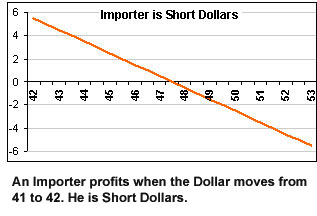
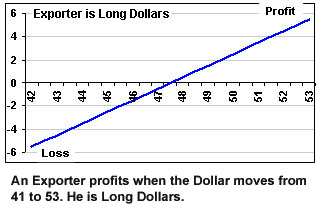
Your exposure is your position in the forex market. As an Exporter, you are to receive Dollars in the future and are therefore Long on the Dollar. Similarly, as an Importer you have a liability to pay Dollars in the future. So, you have a Short Dollar position in the forex market.

Agreed, trying to make money from forex trading (repeat, from forex trading) is not what you should be doing. But, it is a fact that your exports and imports have saddled you with a forex position.

You have no choice but to manage that position. Might as well do it well, no?

Even the RBI encourages corporates to manage their forex risk. Shri G Padmanabhan, Executive Director, Reserve Bank of India, has said in a speech “Managing currency risk in the new normal” on 28-July-12, that “The hedging activities of the corporates should be an integral part of their overall risk management policy and mechanism.”

Recognise. Commit. You will succeed.

Saying “forex is not my business” is a defeatist attitude. It is not going to make for success in forex risk management.

Indians are acknowledged as good managers worldwide. Can they not succeed at forex hedging? Of course, they can. There are some very good forex risk managers in some of the companies we have met. They know how to do the job well.

If you yourself are the Promoter/ CEO, are managing the forex risk and have been following the markets for a long time, you are most likely already on top of the markets.

Why then do so many companies report large forex losses? It is because there is a lack of clarity on the key issues regarding forex risk management and hence a lack of commitment to it at the highest levels.

It’s only human. I myself will lose interest in an endeavour if I find that nothing tends to work on an ongoing basis in the long run. I try this, I try that, but nothing seems to work

That is why, my last article highlighted the “Drawbacks of Common Hedging Methods“.

So, what is the way out? If you recognize that forex risk management is an essential part of the company’s business and you commit yourself to it by sanctioning a hedge cost budget, you will be well on your way to hedging success.

Our experience, and our work on the KSHITIJ Hedging Method, tells us that there is scope to generate forex benefits – whether profits on exporters or savings on imports – to the tune of 1% of the exposure.

Try it. It’s worth it. You can do it. Or ask us how to do it. Give us a call. We’ll be glad to help.

98% of companies do not use specialized software to track their exposures (like Letters of Credit, Buyers’ Credits, Rupee Packing Credit etc) and hedges (like Forward Contracts and Options). All the work is, unfortunately, done on MS Excel. Truth be told, this is one of the biggest problems in forex risk management, possibly as big, or even bigger, than managing the market risk itself.

Maintaining forex data on MS Excel is tedious, time consuming and prone to errors. In 10% of companies, this work is undertaken by highly competent executives who are well versed with Excel functions, formulae, macros, pivot tables et al. In another 20-30% of companies, those maintaining the data are reasonably proficient in Excel. Unfortunately, in more than 50% of the companies, especially in SMEs, the work of maintaining the data is done by clerical staff that is, many a times, unaware of some of the basics of MS Excel.

This can prove to be a very big hurdle in getting correct and timely information on forex exposures, making it impossible to manage the market risk effectively.

Most companies do not use specialized forex software because affordable software suited to Indian conditions did not exist till very recently. There is good news on that front, though. There is an Indian company in Bangalore that has written a specialized software for tracking forex exposures and hedges. If you would like to know more about it, please write to us at info@kshitij.com.

Coming back to the topic, in this article, I will give you ONE tip on how Excel can be used better for the purposes of forex risk management. Many of you may already know this first tip that I am going to share below. In the next article I’ll give you another tip and there are good chances that the second tip will be a new one for you. Either way, make sure you show this to your junior staff members, who prepare your forex exposure and hedging reports for you.

Calculate Due Date automatically in Excel

Enter the Date in DATE format in Excel

All companies have to track various due dates for transactions like LCs, buyers’ credits, interest payments, forward contracts etc. Here is an example of how Excel can be used to make life easier.

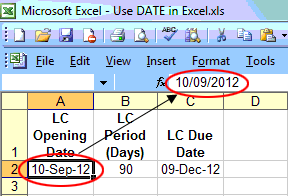
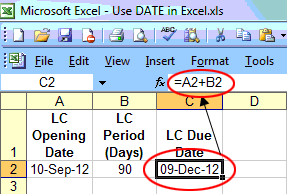
Let us take the example of a Letter of Credit. Some people enter the Date in TEXT format. They then calculate the LC Maturity Date on a calculator and again enter it in TEXT format in the next column. And then, if the LC Period is extended, they calculate the Maturity Date manually all over again! This is like having a car, a driver, a tank full of petrol and still going walking to work. Instead, all you have to do is enter the Date in DATE format. You can then use the date in calculations to automatically arrive at the due date. This is not possible if you enter the Date in TEXT format.

Enter the LC Opening Date in DATE format and the LC Period in NUMBER format. Then the LC Due Date can be calculated by Excel using the formula “LC Opening Date + LC Period”. Simple? Of course. Excel is meant to do that for you. Obvious? Yes.

Why enter Dates in DATE format?

Calculate-with-DATE

When you enter a date in DATE format, instead of TEXT format, you can

Do addition and subtraction on Dates, as shown in the example above. This is useful for calculating various due dates, and for calculating things like Interest Period when given two dates. The ability to calculate automatically makes life easier when LC or BC are extended.
Sort data on Date. This is useful to sort things like LCs or Forward Contracts on their due dates and put them into monthly buckets. You can then use this date-sorted data to figure out the period for which your forex risk is most acute, so that you can take hedges accordingly.

TIP:
I prefer recording dates as to read as 10-Sep-12. This avoids confusion between 10-09-12 and 09-10-12, which has started to come from people using different conventions and data files coming from different places. All you have to do is go to the relevant cell and type in “10Sep12” and hit Enter. The data will automatically appear as “10-Sep-12”, in DATE format.

DO, enter your dates in DATE format, preferably as “10-Sep-12”

DON’T enter your dates in TEXT format. Then they are useless to you in Excel. They might as well be in Word, where you can’t use them in calculations!

In the next article I will talk about a more advanced Excel tip. Keep an eye out for that.

NEED A FOREX SOFTWARE?

In case you have been feeling the need for a dedicated forex exposure management software, you can write to us at info@kshitij.com

We can put you in touch with this Bangalore company that has developed exactly such a software for India.