

Author Archives: Vikram Murarka

Vikram Murarka

About Vikram Murarka

Chief Currency Strategist at KSHITIJ.COM. Likes to look at the markets from many different angles. Weaves many conventional and unconventional technical analysis techniques and fundamental analysis into a global macro perspective. Likes to take the road less traveled.

Challenging basic forex risk management concepts

Challenging Basic Forex Risk Management Concepts

At a time when there has been a big jump in risk aversion in global financial markets, this article challenges two revered canons of forex risk management. The article will first build a case that companies should actively manage currency risk, which is otherwise viewed as a “necessary evil”. Second, it will argue that the concept of “natural hedge” goes against the basic tenets of profit maximization for companies and highlight an example where it was profitable for a company to shun a natural hedge even when it theoretically existed.

While preparing to write this article, I was assailed by a bit of self-doubt. Was I a fool, rushing in where angels feared to tread? It was heartening to find that mine was not the lone voice in the woods.

An article entitled “To Hedge or Not to hedge”, cited in GT News on 01-Aug-2006 quoted James Binny, executive director of ABN AMRO’s FX analytics and risk advisory, as saying, “It is accepted now that you can make money out of currency and it should be a useful part of the portfolio.” The article went on to conclude that “ the idea that FX transactions will cancel themselves out over time is one that is antiquated , and few are still prepared to leave anything to chance and ignore this opportunity to trade.” (Italics are mine).

World without theories

Let us go back to the genesis, to a time when there were no theories regarding forex risk management on Planet Earth. We consider the example of a diamond company, domiciled in India , which imports uncut diamonds, invoiced in US Dollars. It cuts and polishes the diamonds and exports them back, invoicing the exports in US Dollars.
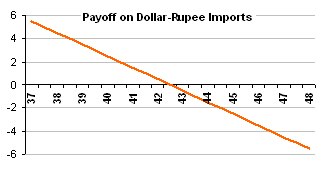
Payoff on dollar-rupee imports Payoff on dollar-rupee exports

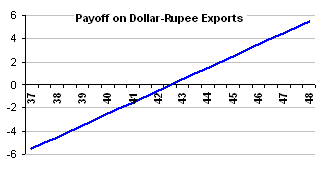
As the charts above show, the company, as an Importer, has an obligation to buy Dollars, which is the same as running a Short position in USD-INR (Fig 1). As an Exporter, it holds a Long position in the export Dollars that it needs to sell (Fig 2). This is the true picture of its foreign exchange exposures, shorn of any theories.

What should the diamond company do? Continuing to live in a world without theories, the company would attempt to buy its Import Dollars (or cover its original “Short” position) at a low rate and at the same time it would want to sell its Export Dollars (or cover its original “Long” position) at a higher rate. Suppose, the company is indeed able to buy Dollars at 42.00 and to sell Dollars at 44.00, it would have captured a net Export-Import margin of INR 2.00 per USD, or 4.65% (2/43) for itself from the foreign exchange market.

Forex is not my business. Is that really so?

This 4.65% net margin is the result of judicious management of the forex rates that the company pays and receives, not from the core business of polishing uncut diamonds. Is there anything wrong in trying to capture this profit? In a competitive world, every variable that a business is exposed to needs to be managed with the intent of adding to shareholder value. Forex is no exception. 

Conventional wisdom says that foreign exchange trading is not the business of a manufacturing company. While one agrees that forex “trading” is not the core business of the company, it is an undeniable fact that the Imports and Exports undertaken in the course of its core business, forces the company to initiate “trades” in the forex market, as demonstrated by Figs 1 and 2 referred to earlier. This fact, as deduced by native logic, flies in the face of established convention, that “forex is not my business”.

A steel manufacturer, although not in the freighting business, tries its best to keep its freight costs down, both while transporting raw materials to its plants and while shipping finished goods out. A car manufacturer, although not a banker, makes all efforts possible to procure working capital at the cheapest possible rates. Thereafter, very legitimately, it tries to deploy any surplus funds that it might have available, at the highest rates possible. Of course, without exposing the company to risk. Variables such as freight, capital and labour costs are integral to each and every business and it is the management’s duty to manage these variables efficiently, and if possible, profitably.

Similarly, although the diamond company in our example might not have wished the forex trades on itself, it does have an obligation to profitably manage the trades it has on hand.
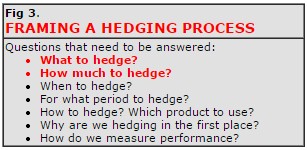
Framing a Hedging ProcessThe process of managing the trades is called hedging. It involves framing the answers to the questions listed in the box alongside, and acting accordingly.

We focus on the first two questions, viz. “What to hedge?” and “How much to hedge?” Continuing in the same vein of using unsullied thought, the answer would have to be that both imports and exports should be hedged, and should be hedged in their entirety (not necessarily all in one shot, though), because these are, after all, the company’s original forex trades, and need to be covered .

Natural Hedge? I want a margin!

Conventional wisdom, however, says that since the company has both Imports, on the one hand, and Exports on the other hand, it has a “natural hedge” and needs to hedge only the residual net exposure, or excess of exports over imports. Say, the company imports diamonds worth USD 100 and exports diamonds worth USD 110. Conventional wisdom would ask the company to hedge/ sell only USD 10. Doing that, however, would mean that it should not try to earn an Export-Import Margin from forex on USD 100. At the most it may attempt to earn a forex margin on USD 10. But that would not really be worth writing home about, would it?

Thankfully, there is enough literature that agrees that a “natural hedge” exists only in theory, given the realities of time and amount mismatches. Even if we assume a situation where the utopian concept of “natural hedge” does exist, a profit-seeking company would still want to buy Dollars for its imports at a lower rate and to sell its export Dollars at a higher rate.
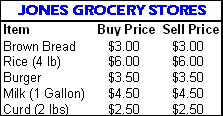
Natural Hedge

What would you think of a grocer who displays a rate list like the one shown alongside (Fig. 4)? Every grocer seeks to be compensated by the customer for taking the trouble of bringing the goods from the wholesaler to a well appointed store in the neighbourhood, for the convenience of the customer. Similarly, the diamond manufacturer would want to secure a reward (difference between its export-import rates) for the currency risk it carries on the entire USD 110, not only on USD 10.

Text Books have not been updated

A bulk of the forex risk management theory in vogue and practice today dates back to the eighties and early nineties (a time when the forex market itself was no more than 15-20 years old) and emanates from bank dealing rooms. It was a time when there were a number of currencies in circulation in Europe , when bid-offer spreads used to be wide and volatility used to be high. Banks did indeed find some positive and negative flows canceling each other out. While managing a mess of several currencies, the banks found it easier to deal with the residual currency amounts. It probably made sense at that time when computers, communication and information systems were less powerful than they are today.

When companies, who were then totally new to tackling currency risk, turned to banks for guidance, the banks simply handed out a manual of what they themselves did, to their clients. Here, it must be remembered that, by nature, banks are risk averse – they seek coverage and collateral at the very outset for the money they lend. Manufacturing companies, on the other hand, thrive by taking risks. “Fortune favours the brave” has been the mantra of all entrepreneurs across time and space.

Further, the eighties and early nineties were times when globalisation and competition were not as fierce as they are today. Profits were easier to come by and companies could afford to leave a few stones unturned during their quest for profits.

Not so today. Times have changed and the textbooks need to be updated. Business competition has increased in general as also in the forex market. Why, Bid-Offer spreads are now down to a few “piplets”, even at the retail level! At the same time, currency volatility has reduced substantially and even George Soros might find it difficult to do an encore of his famous “broke the BOE” trade. Information systems are more robust and real time. In this new environment, there is both a possibility and a need for companies to try and work currencies for their bottomlines, rather than thrusting their heads into the sand like ostriches.

Is it worth it?

Can it really be worthwhile to go against an established belief, to do something radically different? Should the diamond company with a natural hedge really try to adopt a policy of “gross” hedging, rather than “net” hedging? Let the numbers do the talking.
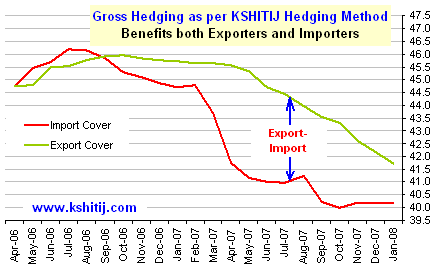
Gross hedging as per kshitij hedging method

We had worked with one such company, using our proprietary concept of “Dynamic Benchmarks”. We did not go by the “natural hedge” concept and instead, hedged both the imports and exports separately. We used only plain vanilla hedging tools as Forwards and Puts/ Calls. Most importantly, we did not expose the company to any additional risk at all. The average hedge ratio was in the region of 56%.

Over the period Apr-06 to Jan-08, even as the Indian Rupee appreciated against the US Dollar, Exports were covered along the Green line shown in the chart alongside (Fig 5). At the same time, Imports were hedged along the Red line, benefiting from the very same appreciation of the Rupee.

As a result, the company earned a very handsome Export-Import margin – from forex – over and above its normal business.
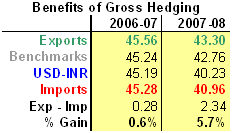
Benefits of gross hedging

As seen in the table alongside (Fig 6), net Export realizations, after hedging costs/ benefits, averaged INR 45.56 per USD in the financial year Apr-06 to Mar-07 and averaged 43.30 in FY 07-08. Net Import costs, after hedging costs/ benefits, averaged 45.28 in 06-07 and 40.96 in 07-08, leaving an Export-Import margin of 0.6% and 5.7% in FY 06-07 and 07-08 respectively. Very satisfactory results – achieved by going against the grain of “natural hedge” – without taking risks or speculating.

The times they are a-changin’

As I finish writing this article, I have before me the views of some of the leading CFOs and Treasurers in Corporate India, as featured in the 06-Sep-08 issue of Outlook Business. Mr NS Paramasivan, Global Treasury Head, Essar Group, for instance, say, “Our mandate is to lower the cost of imports as much as possible and increase the realization on exports as much as possible.”

And there’s nothing wrong with it, really, as long as it is done systematically and responsibly, without exposing the company to undue risk. And, when Mr YM Deosthalee, CFO, L&T says, “We have the ability to convert our treasury to a profit center. But we have no plans to do it yet”, it seems all that is needed now is for the academic intelligentsia to concede that trying to manage forex cost efficiently, perhaps profitably, is not a business crime. Indeed, it is just another avenue to be strenuously explored in the overall interests of creating shareholder value.

This article, authored by Vikram Murarka, has been commissioned by GTNews.com, a leading website on Treasury and Finance related issues
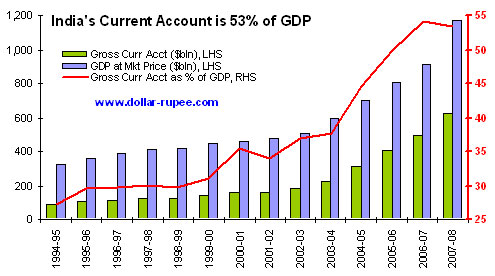
India's Current Account

Developments in the Indian Rupee Market

“Where is the market going?” is the foremost thought that occupies most market participants most of the time. In general the reference is to Price – whether it is going up, down or sideways. The more literal reference of this common question would be to the changes and developments taking place in the marketplace itself. This issue of The Colour of Money takes note of some of the significant developments in the Dollar-Rupee market that have taken place recently.

Importance of the Dollar-Rupee Market

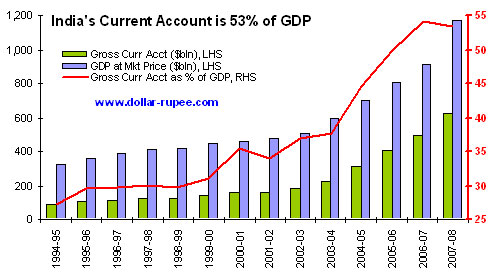
India's Current AccountIndia is now a “trillion dollar economy”, having picked up steam since 2002. It is to the credit of the country’s reforms programme that the openness of the economy, measured by the Current Account to GDP Ratio, has kept pace with, perhaps outpaced, the growth in the economy. The gross total of India’s exports, imports, software exports and personal remittances etc. was equal to 27% of GDP in 1994-95. This ratio has moved up significantly, to 53% in 2007-08. The foreign exchange market is supposed to be an arcane world, which few people know about and fewer can fathom. But, it’s time everybody started figuring out how the FX market works, because exchange rate movements now impact at least 53% of the economy!

FX volumes now rival Equity volumes

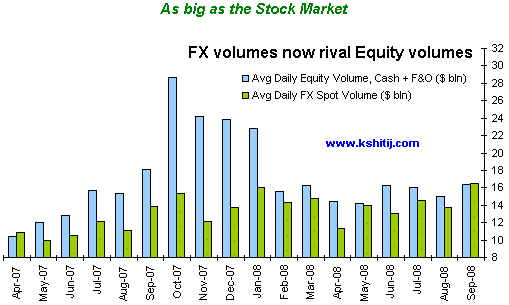
Another reason why people ought to know more about the FX market is that it is now as big as the Stock market. Volumes in the USD-INR Spot market stood at $16.5 bln in September-08, rivaling the volumes (cash + F&O) in the Stock market. On the one hand, volumes in the FX market have risen due to the increasing openness of Indian economy, as cited above. On the other hand, the crash in the Equity market over the last twelve months has led to a sharp contraction in volumes. Daily stock market volumes had fallen by almost half, to $16.4 bln by Sep-08, from the daily average volume of $28.6 bln in Oct-07.

Rising Volumes, Rising VolatilityRising volatility

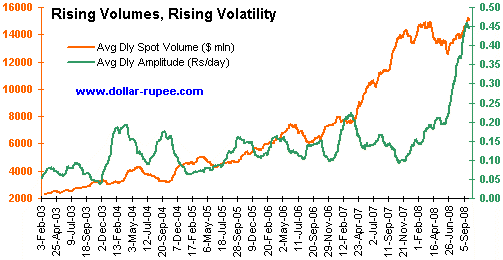
Hand in hand with the rising volumes, volatility in the Dollar-Rupee market has also seen a huge surge in the second half of 2008. We measure volatility as the Daily Amplitude, which is the difference between the High and the Low for the day. This measure has moved up from up from a range of 5-20 paise a day in the five years from 2003 to 2008, to as much as 45 paise a day, by Sep-08. In fact, the Daily Amplitude is a muted measure of volatility because it does not take into account Opening Gaps (difference between the Open on any day and the Close of the previous day). If we factor in Opening Gaps, the volatility will be even larger.

The linkage between the increase in volumes and increase in volatility is that the RBI’s ability to dampen volatility has been severely constrained by the rise in volumes. The RBI has to increase the size of its market interventions now in order to make a dent in the prices. And that is something it cannot always afford to do these days.

Indian Rupee - same commodity, three marketsThree markets for the same commodity

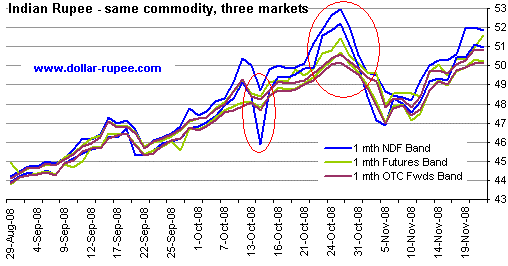
The Dollar-Rupee is now traded in three distinct markets. Prices in each market differ from those in the others, as can be seen from the chart alongside. The Blue band represents the daily high-low for the 1-month maturity in the offshore NDF (Non-Deliverable Forwards) market. The Green band represents the highs and lows in the onshore exchange traded Dollar-Rupee Futures market. Finally, the Brown band shows the highs-lows in the onshore OTC market. Prices differ between markets because participants in one market cannot easily transact in another market, due to regulatory or logistical constraints. Naturally, there is an arbitrage opportunity for the few who can straddle two (or three) markets at the same time.

Note that “delivery” or actual exchange between US Dollars and Indian Rupee is permitted only in the onshore OTC market (which incidentally trades Cash, Spot, Forwards, Options and Swaps). The NDF and Futures markets (which trade Forwards/ Futures only) are “non-deliverable”. The offshore NDF market exists because it permits FIIs to “dynamically hedge” (or trade/ speculate), something they are not allowed to do in the onshore OTC market. Unification of the three markets can be achieved by dismantling regulatory constraints. This would lead to better price discovery for Dollar-Rupee, but perhaps at the cost of greater volatility. Whether that is a worthwhile deal or not, is for the RBI to decide.

EURUSD vs 10yrBund

Bund-Bond Yield Differentials suggest strength in EUR-USD going forward

In this issue
  • Yield Differentials suggests strength in EUR-USD going forward
  • Corrigendum – The Sensex has strength of its own also

Yield Differentials suggest strength in EUR-USD going forward

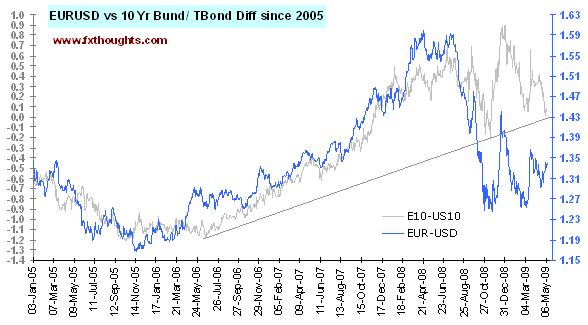
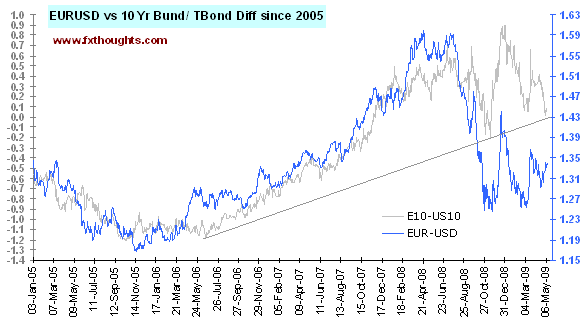
Take a look at the Bund-Bond Yield Differential v/s EUR-USD chart below. The blue line on the graph represents the EUR-USD rates (tracked on the right hand scale) while the grey line charts the differential between 10-yr yields on EUR Bunds and US T-Bonds, on the left hand axis. There is a positive correlation between the Yield Differential and the EUR-USD exchange rate. Simply put, the Euro rises against the Dollar if the Bund yields rise in comparison to the Bond yields. Emerging trends in the yield differential can, therefore, provide a good idea on where the EUR-USD could be headed.

EURUSD vs 10yrBund/TBond Diff

There is a trendline coming up from the Jun-06 low of –1.18% on the Yield Differential chart, joining the Nov-08 low of –0.2%, which now provides support just below the current differential level of 0.06%. Should this Support remain intact, the differential may increase going forward. That would be a positive for the Euro vis-à-vis the Dollar.

USD T-Bond Yields since 2007To determine the chances of the differential increasing going forward we first look at the US Yield chart alongside which shows yields on 10 and 30 yr T-Bonds. The 30-Yr Long Bond yield (4.29%) has reached a Resistance level (see the Red trendline). The 10-Yr yield (3.32%) has the potential to rise some more before it meets Resistance at 3.5%. If the Resistances on the 30-Yr and 10-Yr hold going forward, the yields could fall, sending the Bund-Bond differential up.

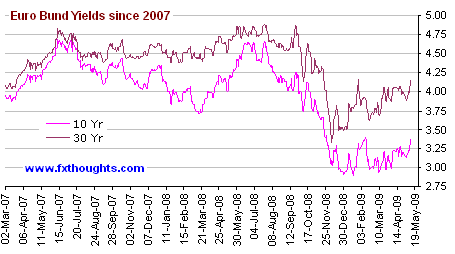
Euro Bund Yields since 2007Further, Euro Yield chart alongside shows that the yields have been rising since the beginning of March ‘09 and have at least a 50% chance of rising further. If so, this too could boost the Bund-Bond yield differential.

All of this, put together, would be bullish for the Euro. However, in case the Bund-Bund Yield Differential (currently +6 bp) goes into negative territory going forward, the Euro could take a big beating against the Dollar.

EURUSD 3 day Candles from Mar'08The make-or-break situation on the Bund-Bond Yield Differential chart is reflected in the Euro chart as well.

As can be seen on the 3-day Candlestick chart alongside, there is a trendline coming down from the Jul-08 high of 1.6038 that provides Resistance near 1.3550.

If and while this holds, there may be a chance of the Euro falling back towards 1.25 in the weeks/ months ahead. However, should this Resistance at 1.3550 break, the Euro could skyrocket to 1.40-42.

The Sensex vis-à-vis the World – A Corrigendum

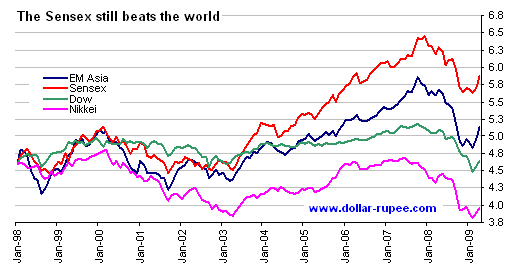
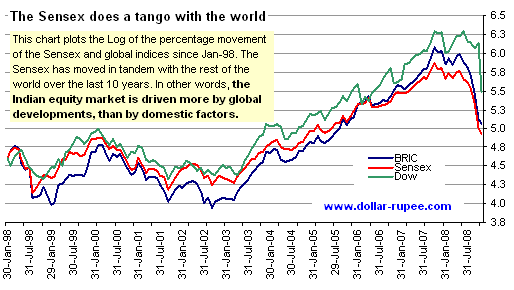
The Sensex still beats the worldThe chart alongside plots the Log of the percentage move in Sensex, Dow Jones Industrial Average, Nikkei and MSCI’s Emerging Market Asia indices since Jan-98. The Sensex is seen to have outperformed all the other indices, compared to the Jan-98 levels. The Sensex outperformed the others in the bull run of 2003-08. Even during the fall of 2008-09, it was beaten only by the Dow. It beat both the EM index and the Nikkei during the fall.

The Sensex does a tango with the worldThis fresh finding contradicts and corrects our earlier assertion that the Sensex moves in tandem with the world, implying there is no diversification benefit in the Sensex (and by extension, India) vis-à-vis the rest of the world. The incorrect chart, which was published in our annual print Calendar, is given alongside for reference. The error occurred due to reference to an incorrect data series, and somehow escaped internal quality checks.

We tender sincerest apologies to all concerned for the error.

USDINR Volatility

Why Forex volatility is increasing and how to tackle that

Rupee Volatility has increased The last couple of years have been particularly painful for Corporate India in many ways. Forex Risk Management has been one of the ways by which several hundred crores were lost. In one famous case, a company lost close to Rs 1500 Crores, and went from a net profit in 2007-08 to net loss in 2008-09. Also famously, an Accounting Standard was changed to allow companies to capitalise forex losses on foreign loans.


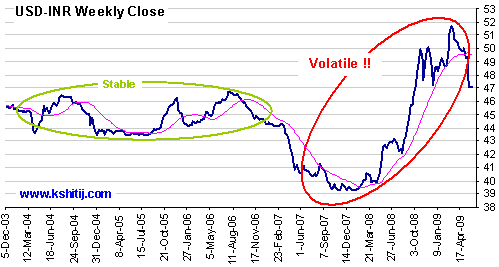
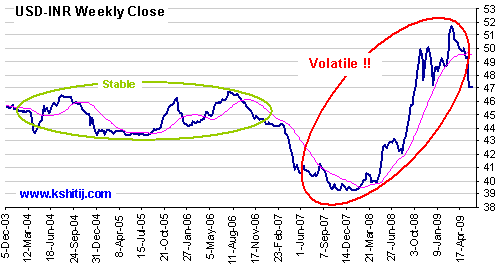
Usdinr weekly close

 What went wrong? Most obviously, there was a sharp rise in Dollar-Rupee volatility. Compared with an annual range of 10% (between 43 and 47) from 2003 to 2007, Rupee gained 11% in 2007 and fell 33% in 2008-09.

The less obvious, but more important, thing that went wrong was that the forex risk management techniques used by Corporates came a cropper.

This article makes two contentions. Firstly, forex volatility is here to stay and the sooner Corporate India learns to deal with it, the better. Secondly, extant forex risk management techniques of Corporate India are by and large illequipped to deal with volatility (as has been amply demonstrated) because of some fundamental flaws. The article does not end on a negative note, though. It proposes a set of questions that the top management, including the Board, of companies needs to introspect on and answer, if they want to be able to deal with the new reality of forex volatility.


Usdinr Monthly Volatility

Volatility to remain high

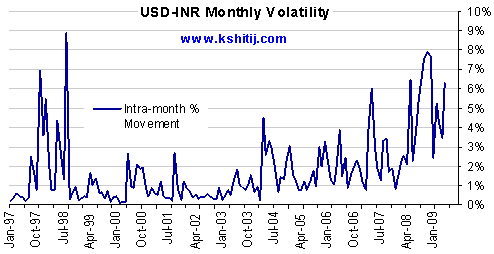
Over the years, there has been a trend increase in Dollar-Rupee volatility, measured by the percentage movement in a month. The Rupee used to fluctuate an average of 1% (or 45 paise) earlier, but the monthly fluctuation is now averaging 5% (about 225-250 paise). Moreover, the volatility is likely to remain above 3% (135-150 paise) in the future.

The main reason behind the structural increase in volatility is the growth of India’s Current Account, including exports and imports of both goods and services, and India’s Capital Account, which is witness to a high degree of volatility in portfolio investment flows. This has led to a huge increase in the daily turnover in the Dollar-Rupee market, to such an extent that it is now increasingly difficult for the RBI to contain the volatility on a daily basis. As the economy continues to grow and open up, it is unlikely that forex volatility is going to decrease. As such, the sooner Corporate India realizes that forex volatility is a fact of life and learns how to deal with it, the better.

Unfortunately, the way Corporate India has been managing forex risk so far is woefully inadequate to deal with currency volatility. The bleeding financial statements of companies are a testimony to this fact

Fundamental Flaws

The forex risk management systems in Corporate India suffer from some fundamental flaws. Three of these flaws are listed below :

1. No Benchmark

The unadmitted, but implicit, objective of forex risk management in a very large number of companies is to try and beat the market. There is a lot of pressure on the forex desks in companies to make profits. Do not go by what companies say in their annual reports. Ask the dealers and risk managers in the treasury departments of companies to verify this statement.

This happens because a most companies set no Benchmark by which forex risk management is to be guided. As a result, the market becomes the default benchmark and everybody tries to beat it. Hedging decisions are assessed on whether or not the hedge beats the market.

2. Fixed Benchmark, if at all

The few companies that work with Benchmarks tend to have a Fixed Benchmark for the whole year. One particular USD-INR rate is decided upon during the annual budgeting exercise in February-March, and then hedges are undertaken accordingly. This is done because (a) a fixed benchmark lends itself easily to budgeting (b) the marketing and production departments in a company do not want to deal with a “non-domain” variable and (c) there is still an innate “wish” in the minds of most people that exchange rates should remain steady.

<p>However, this approach is far removed from reality. The currency market, like most other markets, is volatile and given to wild swings. The factors on which the annual currency forecast (and benchmark) is based are likely to change. As such, there is a need to revise the Benchmark. Unfortunately, the system is inflexible and does not allow for changes in benchmarks, does not allow for any course correction.

3. No Budget for Hedging

It would be a very rare company, indeed, that had set aside a budget for Hedging in 2007 and 2008. Although every activity in business has a budget allotted to it, be it as mundane as the daily upkeep of toilets, Forex Hedging is supposed to be, or so it seems, costless. That is why forex hedging budgets are unheard of. And that is why we witnessed the phenomenon of hordes of companies taking on 1×2 Put Risk Reversals in 2006 and 2008 to hedge their Exports.

Buying a simple, plain vanilla Put costs money and no company had provided for that. So everybody tried to go in for “zero cost options” and ended up with losses that were several times higher than the option premium they could have chosen to pay earlier on plain vanilla Puts.

Nine Vital Questions

Of course, it is easy to point out what’s wrong. It is more difficult to suggest a solution. Companies need to do some hard introspection if they want to find a way out of the current mess that is forex risk management. A set of nine vital questions is proposed below, which companies can ask themselves. The answers to these questions can pave the way for better forex risk management going forward.


QS 1. What is our FX Risk Management Agenda?

The agenda could include anything, ranging from “We want to avoid losses” to “We want to make profits” to “We want to train our people” to “We want to upgrade our treasury software” etc.

Here, let it be explicitly added, there is nothing wrong in having “We want to make profits” as the agenda of forex risk management. What is important is that the objective be approached in a proper manner.


QS 2. Have we quantified our FX Risk Management Objectives for the year?

Whatever objectives have been included in the Agenda in (1) above, they need to quantified. For instance, if the agenda is to “Avoid losses”, it needs to be quantified as to losses beyond which level are to be avoided, because losses cannot be totally nullified without sacrificing profitability. This also presupposes that work has been done to estimate what quantum of losses is possible and what impact it can have on the companies financials.

Similarly, if the objective is to make profits, the company needs to estimate the profit potential and needs to set out the profit targets that need to be achieved. It also needs to quantify the potential risk in its pursuit of profits.

Without putting numbers to the objectives, the objectives will remain mere homilies.


QS 3. The production and marketing guys have their budgets. Have we worked out a Hedging Cost Budget?

Any and every activity requires some expenditure. Then why not Hedging? Stop Losses on Forward Contracts that go wrong and Option Premium on plain vanilla puts and calls would be paid for from the Hedging Cost Budget. It would make the life of the forex risk manager much easier and actually enable him and empower him to achieve the set objectives.


QS 4. How do we measure FX Risk Management performance? Are we trying to beat the market, or better a Benchmark?

In the absence of quantification of objectives, it becomes difficult to assess the performance of the FX Risk Management function. And by default, and by application of accounting rules, the company ends up trying to beat the market. This happens despite knowing that it is impossible (and even unadvisable) to try and beat the market on an ongoing basis.


QS 5. Is our Benchmark based on the past, present or future?

In the rare instance where a company (say an Exporter) sets a Benchmark, it tends to take the rate on the date of bill of lading as the Benchmark. Or sometimes the average exchange over the last 3 to 6 months may be taken as the Benchmark. Another common practice is to take the Forward Rate on a particular date as the Benchmark. The question is, are these practices effective and correct? If not, is there a better way?


QS 6. Where does Risk lie: in the past, present or future?

This is a rhetoric question. A moment’s thought will tell us that risk lies neither in the past not the present, but in the future. And we also know that the future is likely to be different from the past and the present. So, it is the future that the FX Risk Management team should be concerned about.


QS 7. The market is ever changing. Is our benchmark fixed? Or Dynamic?

In anticipating the future, companies tend to make a “single number” forecast for the entire year ahead and take that to be the benchmark. The reasons why they do that have been outlined earlier in the article. But, it is hardly correct to do so, because the conditions on which that forecast was made are quite likely to change in the future. As such, there will be a need to revise the forecast based on the new, changed conditions. How many companies allow for such change in forecasts and Benchmarks?


QS 8. Are we more concerned with the performance of our Hedges than of our Exposures? Why?

Most companies become very concerned when a Hedge (Forward Contract or Option) goes out of money. In a case where the Exposure (the Export or Import itself) is not fully hedged (an optimal hedge ratio would be about 54%), there should actually be joy if a Hedge goes out of money because when a Hedge goes out of money, the Exposure ends up making money.

The problem occurs because within companies, the profit or loss on Hedges is deemed to be “Treasury profit/ loss” while gains/ losses on the Export/ Import itself are taken to be non-treasury, business gains/ losses. Most managers on the FX Desk in most companies lament this fact. There is a lot to anser for when a hedge goes out of money but there is nary a pat on the back when an exposure that has been purposely left unhedged goes into the money.

Clearly, there is a need for deep introspection within companies on this point. The FX Risk Manager seems to be the most hassled person in a company, in a constant danger of being crucified. Why?


QS 9. Are we willing to explicitly pay for Advice? Should advice be paid for separately from the commission/ brokerage payable on hedging transactions?

Lastly, very few companies recognise the benefits of divorcing advise from transactions.

Banks have tended to proffer free advise in order to attract companies to hedge through them. Companies, on their part have been happy to receive the free advise from banks. They are generally loath to pay explicitly for advice, not realizing that this is, in fact, the better option for them. Free advice has often played on the fear or greed of a Corporate, to induce it to hedge. The truth of this is borne out by the strange phenomenon of Corporate India as a whole selling Dollars at 40-41 in 2008, based on the advice that it would fall to 35.

Had companies sought independent advice, perhaps they might have been able to get an opinion to the contrary. Learning from experience, some companies have started to seek advise from independent, professional risk managers, instead of relying solely on the free advise given by banks. This is a step in the right direction, but there is still a long way to go.

Volatility can be tackled

Companies, especially in the manufacturing sector, routinely deal with the volatility in the prices of their raw materials as well as their final products. And they tend to do so successfully, turning in a neat net profit, year after year. Why then can they not deal with currency volatility, which is, in fact, much less than commodity volatility? What is needed is a proven method of tackling currency volatility. Such a method exists and is arrived at by introspecting on and answering the nine vital questions given above.

1 “Developments in the Indian Rupee Market”, Colour of Money, 22-Jan-09, by Kshitij Consultancy Services
2 “The need for focusing on the Currency Risk Management Process in the Corporate sector”, Colour of Money, 16-Feb-08, by Kshitij Consultancy Services
3 “How paying Option Premium can actually be profitable”. Colour of Money, 16-Feb-08, by Kshitij Consultancy Services
FX is a commodity not asset

FX is a Commodity, not an asset

FX is a commodity not asset

Does not have the features of an asset

FX is not an asset because it hasn’t got that most essential feature of an asset, which is to provide a utility to the asset holder independent of any changes in the price of the asset after its purchase, for significantly long periods of time after its purchase. Without quibbling on this, I would say that when the Average Joe purchases an asset, he hopes to be able to use it for at least 2-3 years, if not a couple of decades.

For instance, a car provides the utility of transport, a house provides the utility of shelter, a factory produces the utility of production and so on. All of these assets are fed with some inputs – car with fuel, house with electricity, factory with raw materials – and they produce the utility they are meant to provide. Their ability to produce utility is dependent on the continued supply of inputs, and not on any extraneous change in the market price of the asset itself. Of course, looking at it the other way round, the market price of an asset can vary in accordance with its ability/ inability to produce the desired utility, but that’s a different point altogether.

Financial assets such as stocks, bonds or bank deposits provide the utility of returns by the very virtue of ownership – either interest in the case of bonds and deposits, or dividend (in most instances) in the case of stocks. These returns are accruable to the owner, irrespective of the changes in the market price of the stocks/ bonds.

The prices of all assets, whether physical or financial, can rise or fall – producing capital gains or losses – but all assets continue to provide, over time, the utility they are supposed to provide, irrespective of these price changes. Yes, all physical assets depreciate with wear and tear, which reduces their ability to provide utility, but that is, as said earlier, another matter.

Currencies do not have this characteristic of assets. Currencies are a means of exchange. They are used to buy assets or commodities. Yes, they do provide a utility – they enable the exchange of goods and services, they enable commerce. But the provision of this utility is dependent on the price of the currency itself, through inflation/ deflation in the domestic arena or through appreciation/ depreciation vis-à-vis other currencies in the international arena. This is an essential difference between currencies and other assets. Further, unlike financial assets like stocks, bonds or bank deposits, the mere possession of currencies does not necessarily provide a return. You would have to make a deposit in a bank to earn interest. Note then, that it is the deposit that earns interest, not the currency itself. Yes, there can be gains or losses due to changes in the price of the currency, but the currency itself produces no returns. As such, it would seem that whatever else currencies might be, they are not assets.

More like a commodity

Perhaps currencies are more akin to commodities? Most commodities, such as fuel, metals, wood, chemicals and others, become useful when used as an input in a productive process. The mere possession of the commodity does not necessarily produce a benefit. Similarly, currencies produce a benefit or utility when used as a means of exchange in trade and commerce and in capital transactions. Further, the holding period for most commodities, especially in the physical form, tends to be short. This is in contrast to assets, which the Average Joe wants to hold for a long period of time. Holding a commodity is seen as holding inventory and no one wants to hold inventory for very long, because there are costs attached to carrying that inventory.

Apart from the cost of storage, the biggest cost of holding commodities is the risk of a fall in prices. Of course, there are chances of prices rising as well, but statistically, the chance of a rise in commodity prices tend to be more or less equal to the chances of a fall over a long period of time. Similarly, the holding of currencies brings with it more or less equal chances of a rise or fall in prices. This is unlike the case of assets (like houses, or factories, or gold or brand name), where the chances of a rise in prices are, in the long run, greater than the chances of a fall. There is, thus, prima facie, a disincentive for most people to hold onto commodities or currencies for very long periods of time, or in excess of their requirements, especially in the physical form.

Of course, an entire industry thrives on the holding of commodities. But, this is usually in the form of futures or options. Here too, we find that the holding period for most futures or options tends to be rather short, especially in comparison with the holding period for even financial assets. The open interest in most Futures markets, for both commodities and currencies, tends to be concentrated in the first three months, with the first month having the highest open interest. People are, for the most part, interested in trading the commodity or the currency, buying and selling it for small profits in short periods of time. Few people tend to hold a commodity or currency futures for periods beyond three months. In fact, a few minutes to a few hours is the norm for the greater number of participants in the currency market. Clearly, therefore, gains in the currency market are in the nature of trading gains (which is a characteristic of commodities), rather than capital gains (which is a characteristic of assets).

Further, it is an oft-quoted fact that the global currency market is the biggest market in the world, with volumes approaching $3 trillion per day. The market for the G7, or Major, currencies is highly liquid and not amenable to “cornering” or “price rigging”. Individual participants in the market have no hope of influencing price. So much so that these days even Central Banks, especially of the G7 countries, have largely given up on the practice of Intervention. The global currency market is the closest that one can ever come to the utopian concept of Perfect Competition in a market, where there are a large number of participants, there is no barrier to entry or exit of participants and everybody shares instantaneous and complete information.

In effect, the global currency market is a wholesale market, the biggest of them all. And, wholesale markets deal in commodities, not assets. We do not find Rembrandts, Picassos, Van Goghs, or Bikash Bhattacharjees being traded in wholesale markets. Maruti 800s, and even Honda Citys, are commodities, when compared to cars like Ferraris and Porsches, leave alone F1 cars.

How does this help?

Alright, suppose the debate is settled, or at least, it is personally settled for me (until someone with better logic unsettles me) that currencies are commodities, not assets, how does that help in generating better returns, or Alpha?

Firstly, we realize that all “returns” in commodity (and currency) trading is Alpha because the commodity produces no returns on its own. Secondly, we can shun some of the techniques of investing in assets, such as “Buy and Hold”. Thirdly, we realize that while all returns in currency trading is Alpha, the Alpha, in turn, is generated from trading. Thus, we start looking for ways of trading better.

We can draw inspiration from the fruit or vegetable seller, whether he be running a small shop, or he be a wholesaler. Both look to make a small margin on each sale and would rather let the stock go at cost than to see it go waste at the end of the day, resulting in a loss. He does not look to, on an average, make more per kilo or ounce sold, than is available in the market at the going price.

Cut to the currency market.

If we act like the fruit seller, we will change our tactics. Instead of trying to figure out things like, “Is the Euro, or the Yen, going to go up or down”, we will try and spend more time working out how much profit per trade is generally possible to achieve. Having known that, we will try and increase the number of trades we do wherein we can get that average profit per trade we are looking for. This will also help us control our greed and we will not mind cutting losses fine and getting out of a trade at a meagre profit, or at cost, or at worst, a meagre loss. Disinvesting ourselves of the notion that we are investors will help us become better Currency Traders and thus help us generate Alpha.