


Author Archives: Vikram Murarka

Vikram Murarka

About Vikram Murarka

Chief Currency Strategist at KSHITIJ.COM. Likes to look at the markets from many different angles. Weaves many conventional and unconventional technical analysis techniques and fundamental analysis into a global macro perspective. Likes to take the road less traveled.

Kshitij 21 Years of Reliability

Stop Press! Or, why KSHITIJ.COM is reliable

Kshitij 21 Years of ReliabilityMerriam Webster defines “Quality assurance” as “a program for the systematic monitoring and evaluation of the various aspects of a project, service or facility to ensure that standards of quality are met.”

Over the years, Kshitij.com has been constantly refining its forecasting processes and this has resulted in the reliability of our forecasts increasing from 40% in 2008 to 72% in 2016.

For, at Kshitij.com, we have a very simple understanding of quality. We can know that a bakery is good when the baker serves his own cake at his daughter’s birthday. A barber should be ready to cut the hair of his own son and a tailor’s son should be ready to wear the trouser his father stitches. In simple terms, we have to be ready to use our own analysis and forecasts. And, we ourselves are not all easy to satisfy.

Every step of a report is checked and rechecked multiple times before it can be published but sometimes, even that is not enough for us.  Something like this happened recently.


STOP PRESS

A few weeks back we were on the verge of publishing our January 2017 Quarterly Dollar-Rupee forecast. The report was ready to be sent to our Clients. But, something was troubling us. Just when we were going to press the “Send” button on the mail that was to go the clients, we held back for a final check. It was a classic Stop Press moment.

The report had a Sensex/MSCI World Equity Index ratio chart in it (see Chart A below).  The chart was bullish, using both classical charting (trend lines) and Elliot Waves. The implication was that Sensex could outperform the MSCI World Equity Index by a monstrous 48% over the next few years. We were excited about sharing this bullish implication with our Clients.

Chart A: Since 2003
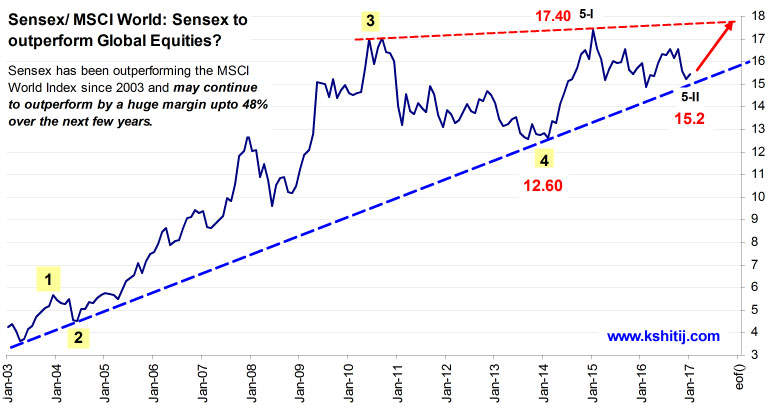
Sensex to outperform Global Equities

Elliot Wave projection details:

Assuming 5-iii to be at least 138.2% of 5-I gives us 21.83 as the 5-iii top, much above the red trendline, which provides the first resistance/ target near 17.80. If 5-iv retraces 38.2% of 5-iii, then 5-iv may end at 17.73 and a final 5-v may make a top at 22.53, assuming equality between 5-I and 5-v. A rise to 22.53 from 15.2 translates to a huge appreciation of 48.22% over the next few years.

Still, we felt a bit uncomfortable with the chart since we did not know the historical context of the chart before Jan 2003. We wanted to see the price chart prior to 2003 as well just so that we knew what had happened earlier.


LOOKING FOR LONGER HISTORY

While we had a long history of Sensex in our proprietary database, we did not have a correspondingly long history of the MSCI World Index data.  It was going to be hard work searching for historical data. But the team was feeling dissatisfied with the chart and so it went ahead and searched for the data.

The search yielded the desired data for MSCI World (from 1987) which expanded the time horizon by 16 years going back to 1987 and when plotted on the chart, brought forth new perspectives. The trend structure was more clearly understood now and fresh insight was available.

Chart B: Since 1987
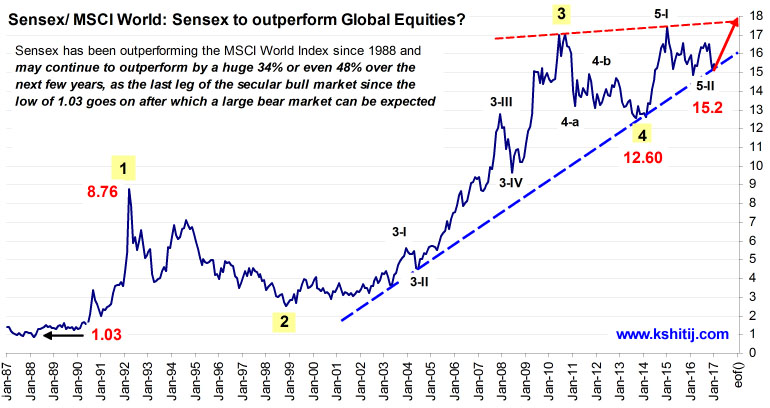
Sensex to outperform Global Equities in a larger time frame

Elliot Wave projection details:

Assuming equality of the large 5th wave to the 1st wave (from 1.03 to 8.76) gives us 20.33 as the initial target, about 34% higher from the low of 15.2. Interestingly, equality of 5-iii to 5-i gives us 20, coinciding with the target of 20.33 seen earlier. This is just a little less than the 22.53 target calculated on the first chart.

This new, longer period chart was also bullish using both classical charting (trendlines) and Elliot Waves. The highly bullish implication didn’t change but the perspective definitely changed a lot.

DIFFERENCE MADE BY THE LONGER TERM CHART

1)      We got a major confluence target of 20.33 (appreciation of 34%)

2)      If the large 5th wave takes an equal amount of time to the large 1st wave, then this target of 20.33 can be met in the next 2 years.

After the targets of 20.33-22.53 are met, we can expect a major bear market to unfold in the coming years, which would imply that the Sensex may underperform the World market for a decade, after the current upmove ends in a few years.

WHY WE DID ALL THIS

Looking at the final result, anyone might say that we could have very well used the old chart, since there was no change in the overall bullish outlook. One may ask if there was any point in the entire exercise of gathering extra data, modifying the chart, and finally even writing about it.

We used the new chart because a longer timeframe always gives a better perspective and gives a better understanding of where we are standing with respect to the historical context. The biggest perspective change we got is clarity that although the Sensex/ MSCI Ratio is in an uptrend for the next few years, this rally may well be the last major upleg of the uptrend that started in 1987-1990.

BECAUSE RELIABLITY MATTERS TO YOU

And what is the purpose of our writing about this entire process? As a Reader, you come to us looking for reliable forecasts. Here we have shared with you our thought process and the care we take before publishing any of our reports. The practical example in this article will help you know why our reports and forecasts are “Reliable”.


PS:
We are the only currency forecasting service in India to publish a track record of the Reliability of its Dollar-Rupee forecasts for the last 11 years (since 2006). Our Reliability has increased from 40% in 2008 to 72% in 2016.

If you need Reliable Dollar-Rupee forecasts, or forecasts on any other markets, write to us as info@kshitij.com
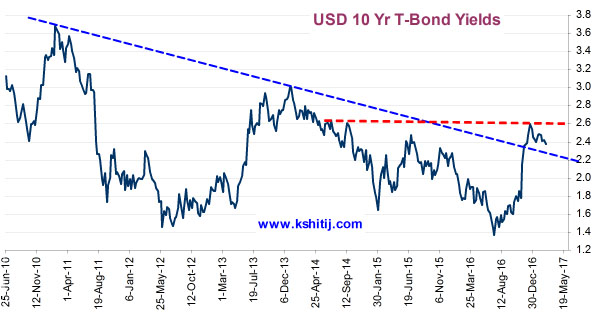
US 10 year Tbond Yields

Study on US Treasury Yields

EXECUTIVE SUMMARY:

Our last reading was for chances of slow decline towards 2.3-2.2% through Feb and March which did not happen, as Yellen possibly does not want to fall “behind the curve” and has kept even a March hike as a possibility. Going forward, it is quite possible that the Yield Curve may actually steepen in the coming months as US Inflation is moving up towards 2.0%, labour market conditions continue to strengthen and US data is doing relatively better than other countries.

US 10Yr (2.38) – Immediate Support at 2.34% and at 2.25%

US 10 year Tbond YieldsThe 10Yr (2.43%) is now caught between Support at 2.25% and Resistance at 2.60%.

It may break higher to target long-term Resistance at 3.00% (high of Dec 13) over the course of the year. Given that the market is pegging a March rate hike at 27%, there will be huge volatility in case the Fed moves early.

 The uptrend is still the dominant trend but there could be chances of sideways movement till March 15th. Support seen at 2.25%.

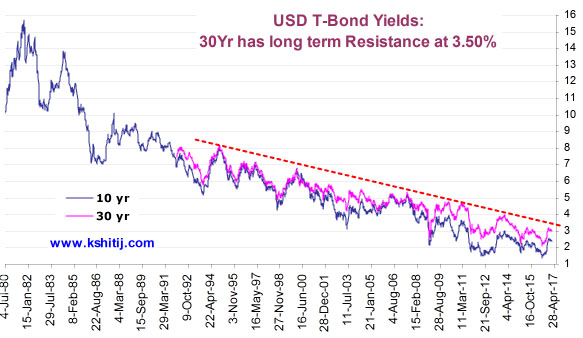
US 30Yr (3.02) – Resistance at 3.06, 3.13 and 3.50% for Mid to Long Term

US TBond Yields 10year and 30yearIn line with our expectation of a dip to 2.90%, the 30Yr (3.04%) made a low of 2.96%.

It now hovers just above its near-term Support at 3.00% so far. It continues to face medium term resistance (since 2010) near 3.13%, and a rise past 3.13%, if seen, can target 3.25% or maximum 3.50%, the long-term resistance since 1994.

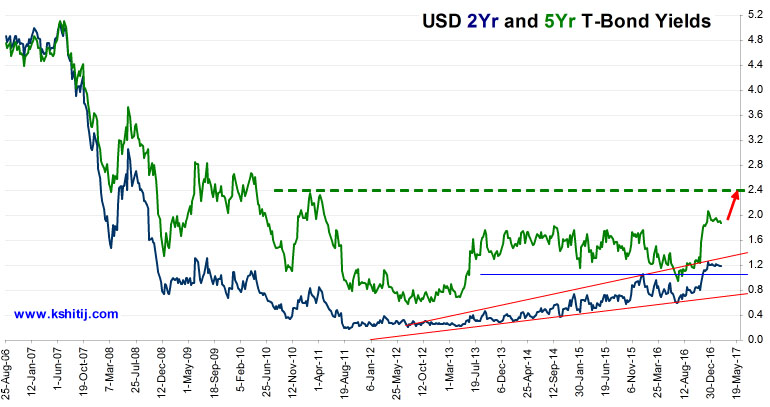
US 2Yr (1.18) – Key Resistance at 1.26; 5Yr (1.87) –Could move up towards 2.50

US TBond Yields 02year and 05yearThe 2Yr (1.22%) may rise only till 1.50% or max till 1.60%. The US 5Yr (1.93%) could see a sharp rise towards 2.50% in the coming months.

Yields may remain sideways, or even rise a bit till the next FOMC meeting on 15th March. Apart from Fed action, yields could rise because of Selling of bonds by the Administration to fund the proposed fiscal push of US$1 trillion, as announced by Trump government.

On its part, the Fed is unlikely to be impetuous in cutting its US$ 4 trillion balance sheet by selling bonds. Its caution is evidenced by the fact that it has said it will stop re-investing funds from maturity of bonds only when it is confident of inflation and when Fed Rates are high enough that they can be pushed down again (to foil a slowdown) if needed.

CONCLUSION:

One of the major global macros the Fed may keep an eye on is Brent, as that may have a direct impact on the CPI.  Currently Brent trades near $56.34, but is inching higher. In case it rises past $58, it could gather steam and try to break above $60 also.  Should that happen fast enough, it could push the Fed into hiking in March itself. While Brent remains below $58, the Fed might wait till June.

USDINR View Mar'16

Have you got the Kshitij.com Advantage?
Highlights of Kshitij Forecasts: 2016

Kshitij has been making long term forecast for almost the last 16 years to help you meet with the oppurtunities that the market inevitably brings.

Ranked #1 worldwide by Bloomberg We were ranked #1 worldwide, by Bloomberg for our Dollar-Rupee forecast in Dec’15.

And to prove that it wasn’t a one off we continued to deliver startling forecasts even in 2016. Here are some examples of forecasts that were outside the consensus when they were made, but were proved correct.

Note: We are the only non-bank forex forecaster in India to have earned this #1 ranking from Bloomberg.


Here are some examples of forecasts that were outside the consensus when they were made, but were proved correct.

2016 Recap: USDINR

What we said :

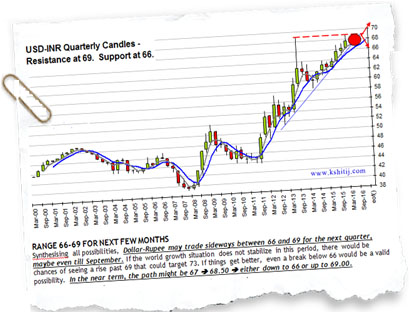
In our Mar’16 monthly report, we had said that USDINR (67.34) may trade sideways between 66-69 till Sep’16.

USDINR View Mar'16

What happened :

USDINR remained stuck exactly between 66 and 69 till the very end of 2016.

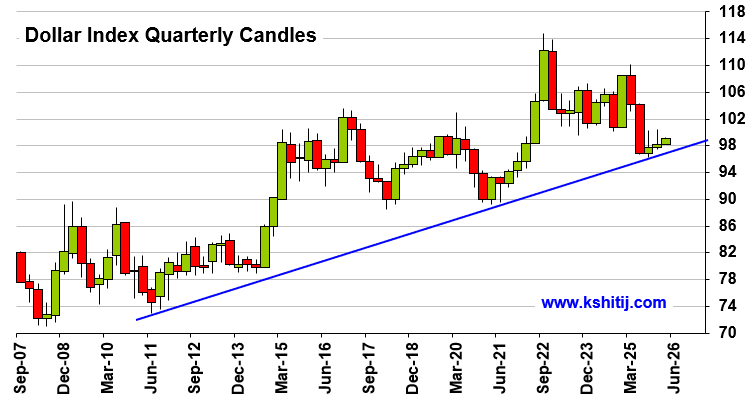
USDINR Quarterly Candles

Download Longterm Forecast Report

2016 Recap: Nifty View

What we said :

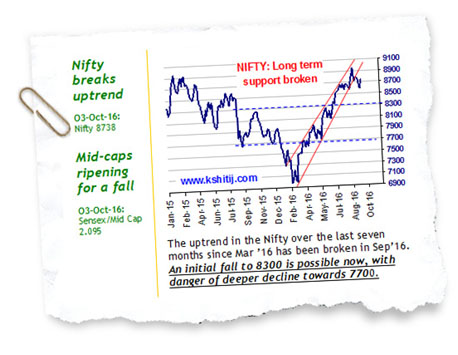
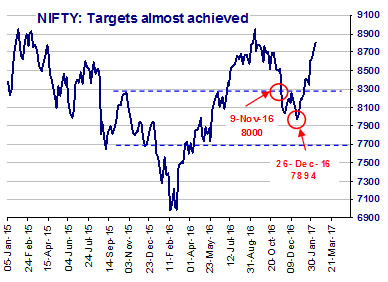
In our Oct’16 quarterly report, we had said that the Nifty could test 8000 and even 7700. (Most people were bullish at that time)

Nifty View Oct'16

What happened :

Nifty tested 8000 on 9th Nov’16 and further made a low of 7894 on 26th Dec’16.

Nifty View Nov'16

2016 Recap: Brent View

What we said :

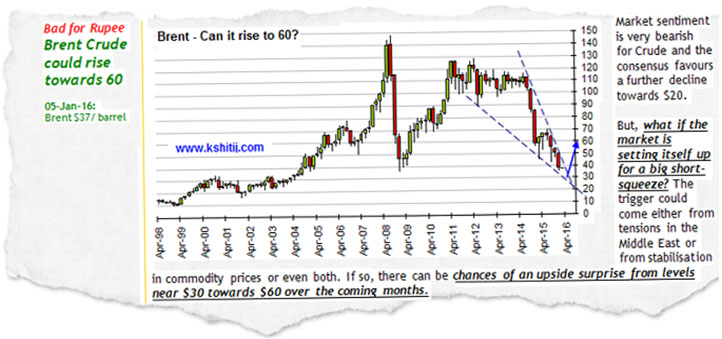
In our Jan’16 quarterly report, it was said that a big short squeeze might push Brent ($37) to $60 levels.

Brent view Jan'16
What happened :

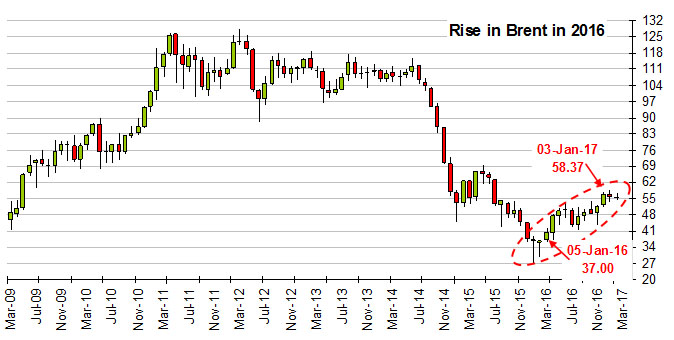
Brent has risen to make a high of $58.37 on 3rd Jan‘17.

Rise in Brent

2016 Recap: DOW View

What we said :

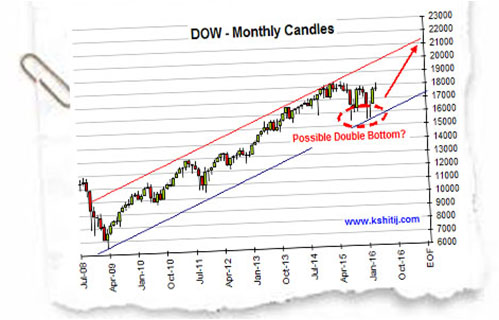
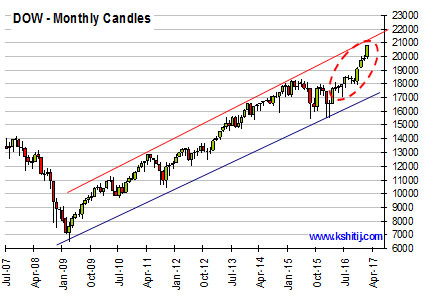
In our Apr’16 article “Can Dow Jones rise 9X times?“, we had said that Dow Jones (17990) might rise to 22500 in the next 12 months.

Dow view Apr'16

What happened :

Dow has tested 21170 on 3rd Mar’17 with the possibility of further rise to 22500 by the end of Apr’17 open yet.

Dow view Mar'17

72 percent reliability And many other such examples makes us the only forecaster with
a 11-year track record of 72% reliability for our Dollar-Rupee forecasts.

To see how we calculate Reliability and to see our 11-year track record, please click on http://72pct.com

Can you afford forex hedging without the KSHITIJ.COM advantage?

  • Our long-term forecasts can help you not only in Forex hedging but even in business planning.
  • Our personalised forex hedging advise not only helps you save costs, but also reduces your forex headache.

Download Longterm Forecast Report

Euro Long term Forecast – May’17

9-May-17 / Euro 1.0907

EXECUTIVE SUMMARY:

Recap: In our April’17 report, we expected Euro to be stable in the range of 1.05-1.10 for a couple of months followed by an expansion of the range with equal chances of a breakout on either side.

There is no change in view as Euro tested but failed to break above the major resistance of 1.10. A break above 1.10 is a necessary condition for further rise to 1.12 and 1.15 but the downside risk remains open till the breakout is seen.

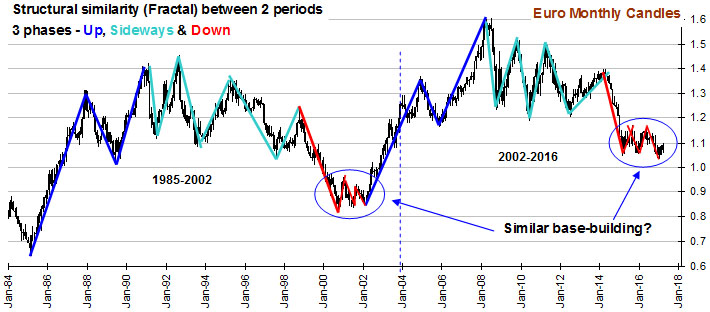
EUR Monthly Candles May17

The chart above shows the structural similarity between two different phases of Euro. It definitely looks like Euro is repeating the structure seen in 1985-2002 since the rally of 2002. In both the cases, the bull market took place in 3 legs (marked by blue lines), sideways consolidation in 6 legs (marked by indigo lines) and a bear market starting with a sharp decline (red lines). Will the current sideways consolidation really turn out to be mirroring the consolidation seen in 2000-02? We don’t know yet but the probability can’t be discarded keeping in mind the overwhelming similarity in its entirety. If the similarity continues, then we can expect a new bull market starting, probably in 2018.


Volatility compression

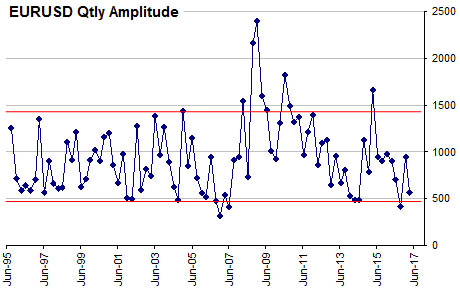
EURUSD Qrtly Amplitude May17The chart on the left shows the quarterly amplitude of Euro or in other words, how much it has moved in a quarter, placed on the time axis to catch any emerging pattern.

We can see the amplitude primarily oscillating around 1000 pips but in the last quarter, the movement has been limited in a much narrower range of 567 pips.

With the broader range defined by 500 to 1500 pips for the last 20 years, an expansion of the amplitude can be expected in the current quarter, implying a sharp directional move.

With 60% of the current quarter still left, the current quarter amplitude stands at 432 pips which look unsustainable. That means, either the current quarter low of 1.0568 or the high of 1.1000 must give way. We have no directional bias inside 1.05-1.10 as discussed previously and prefer to wait and watch.


Correlation between Euro and Swiss

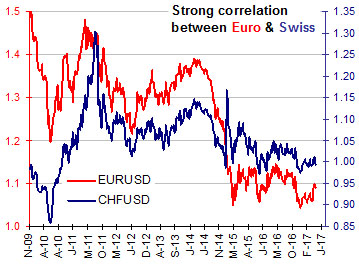
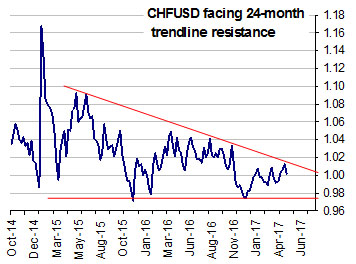
Corelation between euro and swiss CHFUSD facing 24mth trendline resisance

The chart on the left side shows the strong correlation between Euro and Swiss (USDCHF inverted). Swiss was pegged to Euro in the period of 2011-2014 but despite the peg broken in Jan’15, Swiss continues to mirror Euro. As the right chart shows, Swiss (USDCHF inverted) has strong resistance near 1.02-1.03 and an immediate break above 1.02-03 looks difficult, which may cap the near term upside for Euro to 1.10.


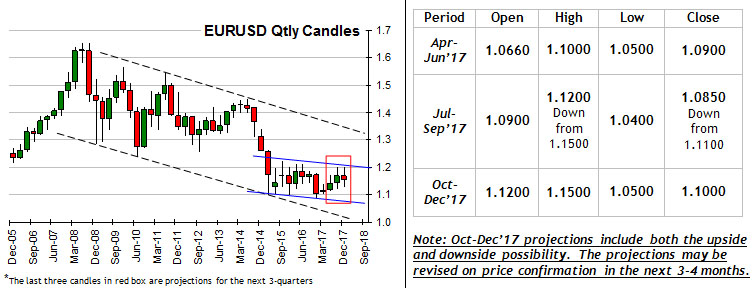
Quarterly Projections

EURUSD Quarterly Projections May17


Conclusion

Euro could be stuck within the broad 1.10-1.05 region in the coming months with no strong directional clue visible. Any failure to rise from either 1.10 may push it down towards 1.07-1.06 but the downside may be limited to  1.04 for the current year.

Japanese Yen Long term Forecast – May’17

09-May-17 / Yen 113.72/ US-Japan 10Yr yield spread 2.36%

EXECUTIVE SUMMARY:

Recap: Dollar-Yen has bounced back from levels just above 108, mentioned as the low for Apr-Jun quarter in our previous report. Now, looking at the next 2-3 months, the currency pair could remain ranged within 108-115 region with a possible extension to 116-118 levels.  


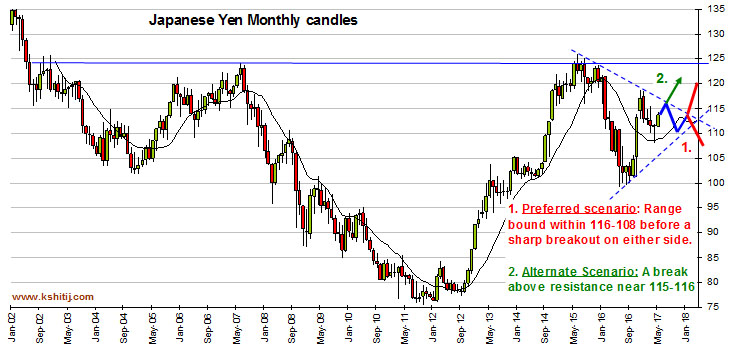
USD/JPY Monthly Candles

Japanese Yen monthly candles May17

Dollar Yen has come down from levels near 118.66 since the last 4-months. While the important support near 108 holds, we could possibly expect a rise towards 114.50 in the coming weeks with a possible extension towards 115-116. Thereafter a fall back towards 108 is possible. Overall a sideways movement within 116-108 is possible till Sep’17 before a sharp break on either side (120 or 105).

Alternatively, we also look for possibility of breaking above 115-116 resistance levels in the first attempt. This is less preferred for now but has a decent chance that the current bounce from 108 could extend towards 120.


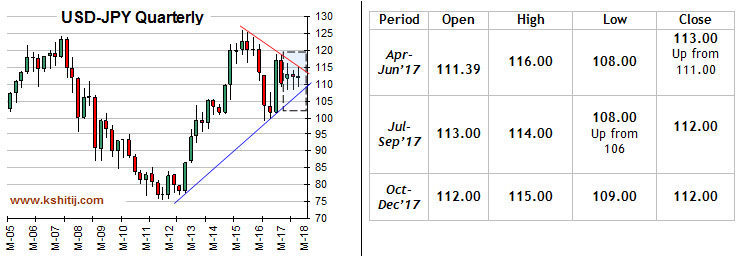
Quarterly Projections

USDJPY Quarterly projections May17

We keep readings for 3-quarters within the 116-108 region intact with a possible extension to 118 or 106 on either side of the range. Thereafter, we would have to wait for confirmation of a break on either side to decide on further course of movement.


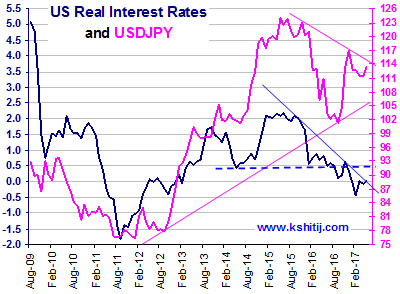
US Real interest rates and USDJPYUS Real Interest Rates

 The US Real interest (0%) rates and Dollar-Yen have good directional correlation and both seem to be heading towards a near term resistance above current levels. In case the respective resistances near 0% and 114.50 hold, we may see a sharp decline in the near term.


We prefer continuation of the current rise at least till mid-June before a decline starts. Although there is enough room on the downside for a sharp decline in both the yield spread and Dollar-Yen, there could be some consolidation or range bound movement before the actual fall. Only on a break above the current resistances would we shift our focus to an upside possibility (120 on USDJPY, 0.44% on US Real Interest Rates).


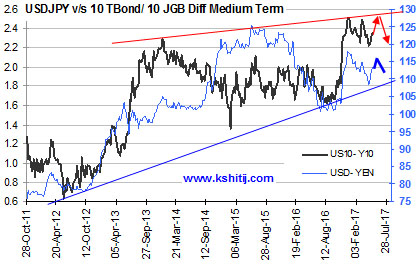
USDJPY vs 10tbond/10jgbdiff medium termUS-Japan 10Yr Yield Spread

The US-Japan 10Yr yield (2.34%) spread could rise towards 2.40-2.50% before coming off to test 2.2%. in that case there could be a possible triple top formation followed by a corrective fall.


Good directional correlation is visible between the yield spread and Dollar-Yen. Overall both could remain range bound for the next couple of months before taking a call on further direction.


Conclusion

 A rise in Dollar-Yen towards 115-116 before falling off towards 108 is the preferred course of movement for the next 3-4 months. A possible extension towards 106 or 118 is open.

Alternate Scenario: The current bounce from support near 108 could break above 115-116 and rally towards 120 without seeing any correction from 115-116. In that case the medium term outlook would be very bullish. We give lesser preference to this just now (about 40%).