


Can Rupee REER fall with Nifty PE?
Apr, 05, 2018 By Saandhy Ganeriwala 0 comments


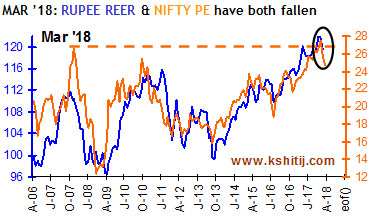 We asked the above question in Dec ’17. The chart of Rupee Real Effective Exchange Rate (REER) and Nifty PE evolved since then, as below:
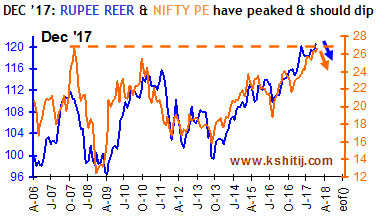 Nifty PE had reached 26.6, which was near the peak last seen in the 2007 market top. Hence, we were unable to be bullish on Nifty PE any more. Moreover, the strong correlation between Rupee REER and Nifty PE (especially seen to be strong near peaks) meant that we were expecting Rupee REER (122.57 in Dec ’17) to be dragged lower with Nifty PE in 2018.
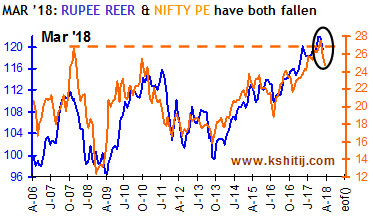 Our view was proven correct. Nifty PE has seen a rather steep fall to 25.68 (Feb ’18) and 24.66 (Mar ’18). Along with it, Rupee REER has indeed been dragged lower from 122.57 in Dec ’17 to 119.51 in Feb ’18.
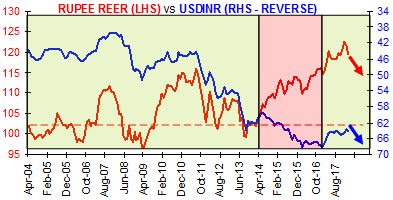 The REER of Rupee tells us how much the market rate for Rupee deviates from its fair value. An REER value above 100 implies that the market rate is overvaluing the Rupee, while a value below 100 indicates undervaluation. Hence, a fall in REER implies that the Rupee’s overvaluation has decreased ie the Rupee has weakened. The green zones in the adjacent chart highlight the close correlation between Rupee REER and USDINR (inverse).
After a phase of divergence between 2014 and 2016*, the correlation has returned.
*This suggests that the Rupee did not weaken as much as it should have during 2014-16.
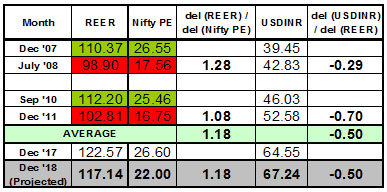 In the adjacent table, we make indicative projections for REER, Nifty PE and USDINR on the basis of past examples, when steep falls in Nifty PE led to a drop in Rupee REER and a rise in USDINR. We project that if Nifty PE falls to 22 by Dec ’18, we could see USDINR rise to 67.
You can view our Economic Calendar with the current chart here.

Saandhy Ganeriwala
Saandhy is a postgraduate in Economics, but like all good market-men, he seeks confirmation from technical analysis charts for his macroeconomic ideas. His research is a good mix of charts, stats and econ. Apart from that, he calls himself a news junkie and an occasional writer.
You may also like:
In our 10-Dec-25 report (USDJPY 156.70), we expected the USDJPY to trade within 154-158 region till Jan’26 before eventually rising in the long run. In line with our view, the pair limited the downside to … Read More
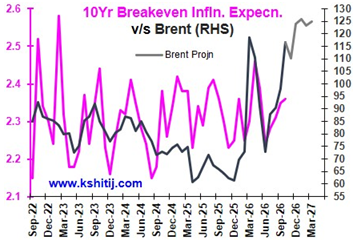
Our last report (03-Oct-26, UST10Y 5.28%) warned of increased chances of Brent rising towards $135-145, US Core PCE rising towards 4.5-5.0% and the US10Yr rising towards 5.80% (Dec-26) and 6.00% (Aug-27). While Brent has risen to nearly $117 and the Core PCE (Aug-27) has inched up to 3.01%, we find that US Yields have fallen across …. Read More
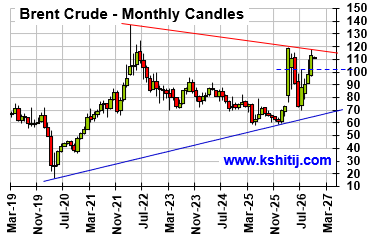
In our October 2026 report (5-Oct-26, Brent @ $101.71), we had stated Brent would be structurally bullish for the long term based on the technical analysis, within which a test of $115 was expected in Oct-26, followed by a test of $134 by Dec-26 and eventually targeting $145 in 2027. In line with our expectation, Brent did test $117.45, slightly higher than our expected $115 in Oct-26. … Read More
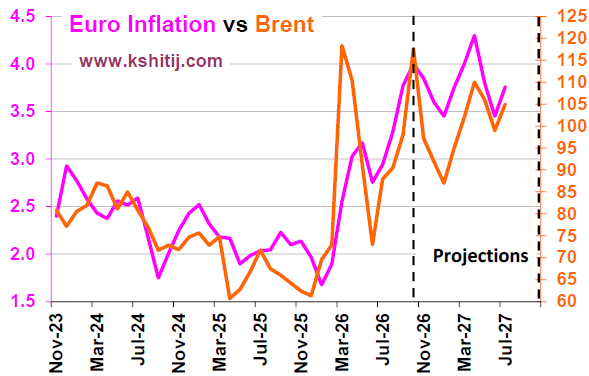
In our October 2026 report (9-Oct-26, EURUSD 1.1250), we revised our Euro forecast downwards on a decline below 1.13 and expected a fall towards 1.10-1.0875 by the next year. Rising crude prices were a concern and were expected to raise the US and Euro yields further, along with the inflation figures. The Euro has been declining while below 1.13 and has tested
1.11 so far. Both the ECB and the FED kept policy rates unchanged in the Oct-26 meeting, while the markets expect a rate hike in the Dec-26 meeting by both central banks. …. Read More
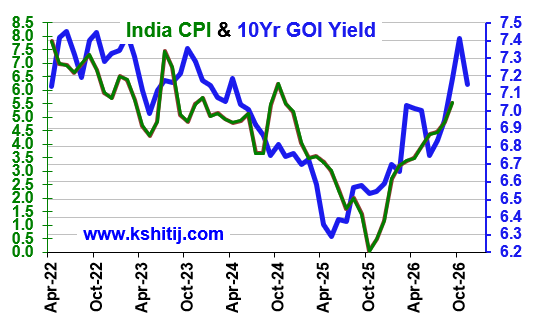
In our 06-Oct-26 report (10Yr GOI 7.19%%), we examined the possibility of the RBI not raising the Repo rate, even though 91% of the market expected it to raise. We were barking up the wrong tree as the RBI did indeed raise the Repo on 07-Oct. Thankfully, our forecasted rise in Brent to $115-120 did materialize well with Brent touching a high of $118 on 30-Oct. We also forecasted that … Read More
Our November ’26 Dollar Rupee Monthly Forecast is now available. To order a PAID copy, please click here and take a trial of our service.