
Author Archives: Vikram Murarka

About Vikram Murarka

Chief Currency Strategist at KSHITIJ.COM. Likes to look at the markets from many different angles. Weaves many conventional and unconventional technical analysis techniques and fundamental analysis into a global macro perspective. Likes to take the road less traveled.

Kshitij Hedging Method Results

How the wheels are beginning to turn on the NEER

Last week, through the red alert and torrential rain, waterlogged roads and WFH, we met 10 corporate forex risk management teams in Mumbai, all the way from Fort in the south to Thane in the north.

Getting 10 meetings in 4 days was a welcome change after the meetings-drought during the last two years when the RBI had artificially pushed Dollar-Rupee volatility down to near zero. Now that the RBI is not breathing down the Market’s neck, a modicum of normal volatility is back in the Dollar-Rupee market and risk needs to be managed again.

It helped, of course, that we have recently been ranked #1 worldwide by Bloomberg for our Dollar-Rupee forecasts for the last two quarters in a row, June-2025 and March-2025. Besides, we have also been ranked in the Top 5 worldwide  by Bloomberg for the last 12 months.

Kshitij Bloomberg Ranking

People were happy to talk with us as we had something path-breaking to offer to them. We provide specific-rate hard-number Open-High-Low-Close forecasts for each month from 1-month out to 12-months for Dollar-Rupee, Euro-Dollar, Crude Oil, US 10Yr Yields and 10Yr GOI Yields. This is part of our regular monthly forecasting service. These are extremely useful for strategizing and planning long-term hedges. Our forecasts come with 60% documented reliability helping the corporate risk managers gain confidence in using them.

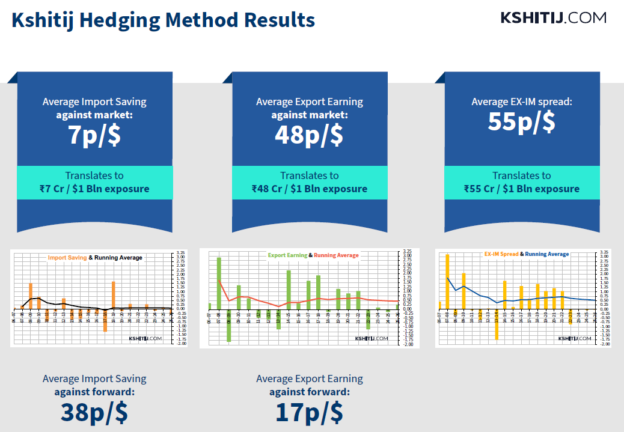
While this is good in itself, the story gets more interesting from here. Building on the reliability of our forecasts, the KSHITIJ Hedging Method model has, on average, helped Importers pay 8 paise/ $ LESS than the open market spot. It has also helped Exporters earn 17 paise/$ MORE than the Forward rate over the last 19 years. Apart from being the only people to publish our forecast track record history, we are perhaps the only people in the Market who can share the results of our Hedging Advice over the last 19 years.

Kshitij Hedging Method Results

This is because we religiously, regularly and systematically calculate the NEER or Net Effective Exchange Rate for both Importers and Exporters and have started sharing the results publicly as well.

Earlier, the concept of NEER was alien to most corporate forex risk management teams because it has never been a management “ask”. Financial accounting standards never demanded it and forex hedging has never been examined from the cost accountancy perspective, as it has been long held (erroneously, of course) that “Forex is not my business”.

To our delight, except for a few, most of the corporates are now at least aware of what the NEER is, some are already calculating their NEER and some are looking to start. We can help here with the KSHITIJ Hedging App, which calculates the NEER on the fly, for both imports and exports. This, besides providing a robust hedging decision support framework powered by the KSHITIJ Hedging Method.

The NEER calculated by the KSHITIJ Hedging App enables the corporate to compare it with the Accounting Rate on the one hand to arrive at the Accounting P/L and with the Open Market Spot on Cash Flow Date on the other hand to arrive at the Opportunity P/L. In a utopian world the aim would be to maximise the Accounting Profit and minimize the Opportunity Loss. However, since that might not be possible all the time, the forex risk management team can try to balance both so that the ratio between the Accounting Profit and the Opportunity Loss can be 1:1. If a corporate can come close to that over a period of time, it will surely enjoy a competitive advantage over its industry peers, proving that managing forex risk is an integral part of the business for every importer and exporter.

We at KSHITIJ are glad to be offer game changing services to corporate hedgers through our 1-12 month hard-number OHLC forecasts, through the time-tested KSHITIJ Hedging Method and through the upcoming KSHITIJ Hedging App.

To wrap up, if the tone of the 10 meetings we had in Mumbai last week is any indication, more corporates are now interested to hear what we are saying, and the wheel is beginning to turn on the NEER. It is a concept that will start rolling soon enough and will eventually become a juggernaut.

Kshitij 60% Dollar Rupee Reliability

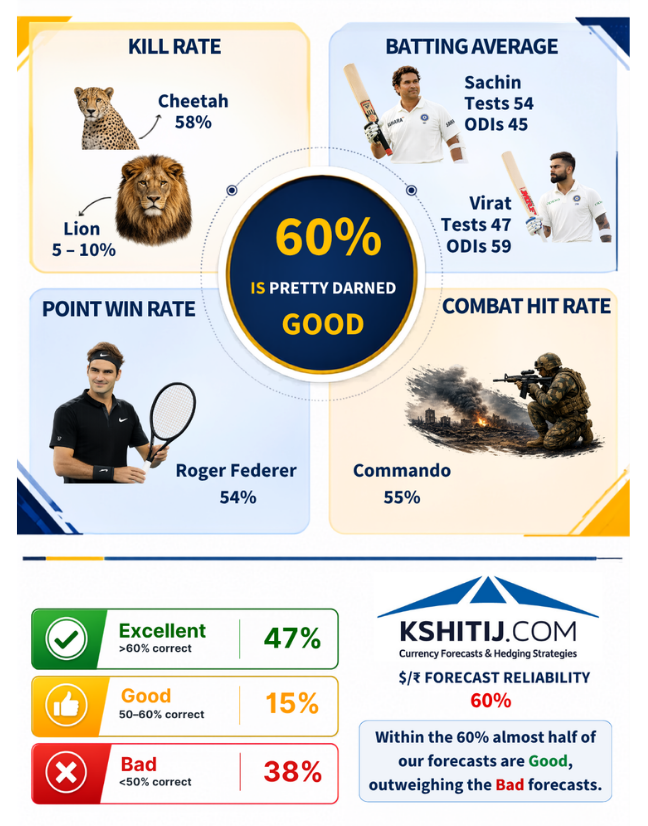
60% IS PRETTY DARNED GOOD!

Kshitij 60% Dollar Rupee Reliability

You might find it incredible but lions achieve a kill rate of only 5%. Cheetahs do better with a kill rate of 58%, but nowhere near the 80-90% that we might expect from such a dangerous predator.

Ace batsmen like Sachin Tendulkar and Virat Kohli show career batting average in the region of 47-48, nowhere near the 80-90 that one might expect. Roger Federer has famously gone on record to say that he has won only 54% of his match points.

Highly trained commandoes who score 90% and higher in training see their hit rate drop to 55% in actual combat.


Kshitij 60% Dollar Rupee Reliability

That the masters of their game do not show scores higher than 60% comes across as a very surprising phenomenon of nature, but its explanation is actually reasonably simple. In the natural world, even the ace performers battling against “entropy” or push back from nature.

The gazelle or the antelope that the lion is hunting is fleet footed; the bowlers that Sachin and Virat are facing are ace wicket takers themselves. Similarly, Roger Federer has been up against formidable rivals such as Ralph Nadal, Novak Djokovic and Andy Murray. The highly trained commando finds himself shooting against a lethal enemy who is both hiding and shooting back.


In simple words scoring above 60% is very difficult in the natural world due to “entropy” and it is because the ace performers are really at the top of their game that they are able to get their scores near 55%. Those lower down on the performance scale might achieve scores in the region of only 34-40% or lower.


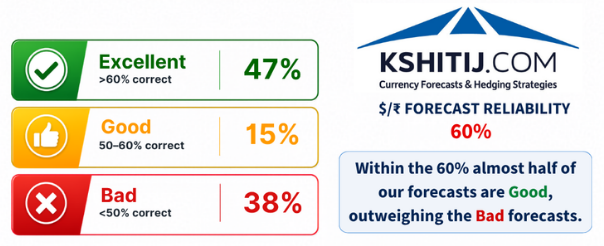
Similarly, our Dollar-Rupee forecast reliability stands at above 60% over the last 20 years. This isn’t just a middling performance. Our track record shows that 47% of our forecasts are excellent and 15% are good, totalling 62% and outweighing the bad forecasts (38%) by a wide margin.

This long-term edge that our forecasts bring is what helps our clients save upto 30-40 paise/$ after all costs, which works out to ₹3.6 Cr on an annual exposure of $120 million or $10 million per month.


Nature and numbers tell us that 60% is pretty darned good!


Talk to us and see how we can help you save more.

To book a free consultation write to us at info@kshitij.com or send a WhatsApp to +91 80170 52073

Forex and human relations

FOREX and HUMAN RELATIONS – ONE GIANT STEP for MANKIND

Forex and human relations

Without a doubt, I can safely say that the forex market has taught me a lot about life. Recently, I had another “A-Ha!” moment, when I gained a crucial insight about human relations from forex.

Curious?

Some background first, though. Please be with me through this, because it is important. Crucially important.

As regular Readers you know that we have been tracking our forecast reliability for the last 20 years and that our overall reliability is 60%. You might also know that we track our error percentage as well. You also know that we provide hard number Open-High-Low-Close forecasts for each month for 1-2-3—12 months.

So, we know that we are right 6 times out of 10 and we also know what percentage our forecasts tend to miss the actual by in each of the 1-2-3—12 month periods. Putting these together, we thought we would make something quite sophisticated, which would possibly give us much better hedging results.

The thought process was as follows:
1) Let us start with the Kshitij forecasts for each month for the next 1-2-3—12 months.

2) Give each a weightage of 60%, which is our overall forecast reliability.

3) Build an alternative forecast series going in the opposite direction of the stated forecast for each month, taking it away from the forecast by the average % error for each month. For instance, if our forecast for the 6th month is that USDINR will rise to 96.00 and our average % error for the 6th month is 2%, then the “alternative” forecast would be 94.08, being 96.00 x (1-0.02)

4) Give this alternative forecast of 94.08 a weightage of 40%.

5) Combining the two would give us a right/ wrong weighted average forecast of 95.23 (being 96.00×0.6 + 94.08×0.4). Let us call this an RWWA forecast.

6) This right/ wrong weighted average (RWWA) forecast of 95.23 ought to be superior to our normal forecast of 96.00 because it takes alternative possibilities and probabilities into consideration. Accordingly, we calculated a RWWA forecast for each of the 1-12 months.

Good so far? Great.

Given that the RWWA forecast seemed to be more scientific and sophisticated than the usual 60% reliable forecast, we started using these RWWA forecasts in REAL hedging decisions for a client for a full year. After that we compared the real results that we obtained against the results that would have occurred had we used the 60% reliable original forecast in our hedge decisions.

To our chagrin we found that the obtained hedging profit/ loss were inferior to what we could have got through our original forecasts! How come?

Then it dawned on us. While we knew we were right 6 times out of 10 and wrong 4 times out of 10, we could never know WHEN we were going to be right or wrong. This being so, by applying a 60% weight to our original forecast and a 40% weight to an opposite-direction forecast, while trying to protect ourselves against the 4 times we were likely to be wrong, we were dragging down all the 6 times that we were going to be right! This gave us a result that was inferior to the one we would have got if we had naturally taken the rights and the wrongs as they came.

Obviously we’ve never used RWWA forecast since then. Experiment done. Mistake made. Lesson learnt.

Now comes the interesting part.

In our closest relations – with our spouse, children, siblings, and with junior team members – we are painfully aware of their propensity to disappoint us in a million and one ways, with no end to their innovation and inventiveness in this regard. However, if we keep reminding them ALL THE TIME of how they are likely to mess things up again like they did on some previous occasion, we are helping no body. We are only making things worse for both of us.

We must remind ourselves that our closest relations are also dealing with entropy in their own lives – bad health, bad moods, lack of knowledge or training, lack of motivation, and crazy sets of unideal circumstances. Even after this, if they are doing good, delivering and coming through well 60% of the times, then they are doing way better than the cheetah, Sachin Tendulkar, Roger Federer, the well trained commando.

Even in Indian marriage match making, it is said that although there are 36 traits or “gunas” that should ideally match between a boy and a girl, even if 21 (58% of 36) of the gunas match, then the prospective alliance is a good one, and the parents on both sides can proceed with confidence.

In short, it is not only that if the KSHITIJ forecasts are right 60% of the times, it is a good performance. If our spouse, children, siblings and juniors are messing up 4 times out of time, we should be happy that they are delivering the goods 6 times out of 10. They are doing pretty darned good, and we should thank our lucky stars that we’ve got star performers in our lives.

Amen.